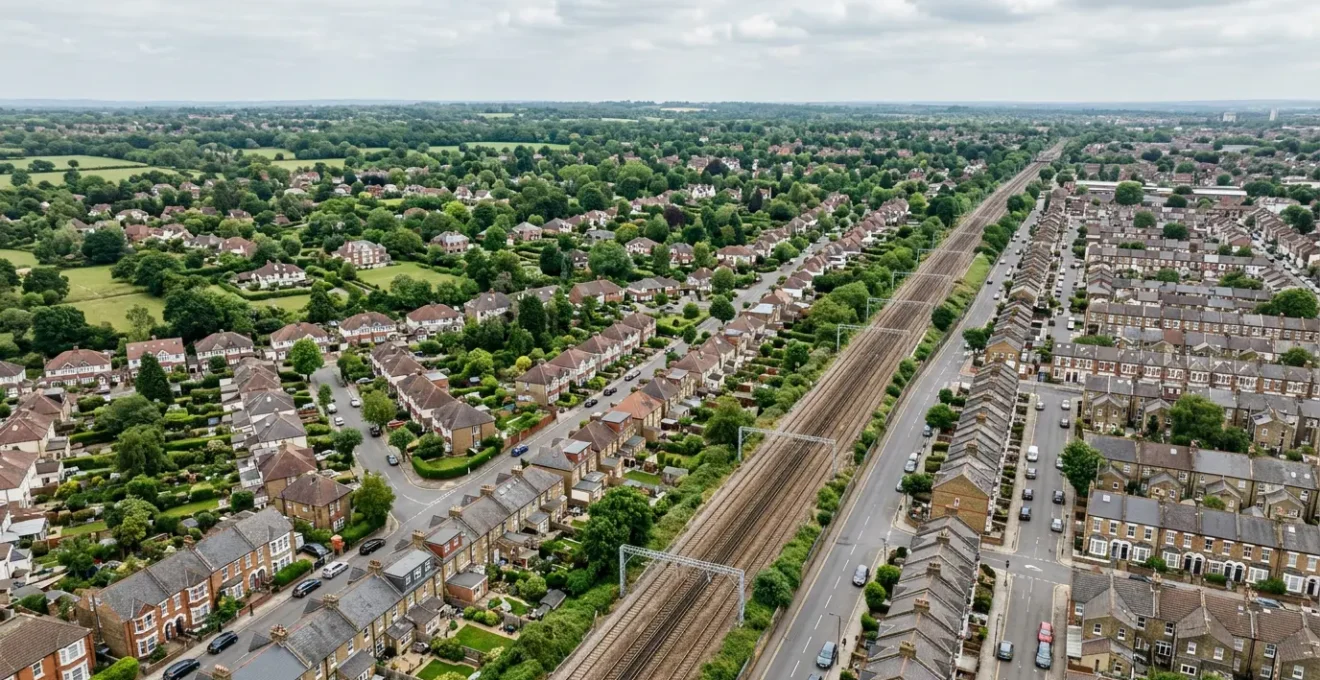
Contrary to popular belief, property value in London’s commuter belt doesn’t simply decrease with distance; it follows a complex, non-linear logic.
- The “Zone 6 premium” is a hard financial boundary where TfL fare caps and Oyster card convenience create a tangible benefit that buyers pay a premium for.
- True value is often driven by non-obvious factors like elite school catchments, council-led regeneration, and international appeal, not just the raw commute time.
Recommendation: To find genuine value, analyse the “Total Cost of Commuting” (time and money) and identify local growth indicators that go beyond major transport headlines.
For any prospective London commuter, the logic seems simple: the further you move from the city centre, the cheaper the property. You trade a longer journey for more space and a smaller mortgage. Yet, as many buyers discover, the property market around London defies this linear thinking. You might find a three-bedroom semi-detached in a leafy Zone 6 suburb commands a higher price per square foot than an almost identical property in a town a full 10 miles further down the same train line. This paradox leaves many buyers confused, wondering if they’ve misunderstood the rules of the game.
The standard advice revolves around balancing house prices against season ticket costs. While a crucial calculation, this approach is overly simplistic. It fails to account for the powerful, often invisible forces that shape value in the commuter belt. It overlooks the psychological and financial impact of transport zones, the value-multiplying effect of elite schools, and the speculative bubbles that form around future infrastructure projects. The assumption that price falls predictably with every mile travelled is the single biggest misconception holding buyers back from identifying true value.
The key isn’t to look further, but to look deeper. The real price of a commuter property is not measured in miles, but in a complex blend of time, convenience, local prestige, and future potential. This analysis moves beyond simplistic calculations to deconstruct the hidden mechanics of commuter belt pricing. We will dissect why the boundary of Zone 6 acts as a price cliff, how to spot the next hotspot before the market does, and why some postcodes seem to operate in a financial reality of their own.
This guide will explore the specific factors that create these price anomalies, providing an analytical framework to navigate the complex tapestry of the London commuter market. By understanding the forces at play, you can move from being a confused buyer to a strategic investor, capable of identifying genuine value pockets that others miss.
Summary: Deconstructing the London Commuter Belt Price Paradox
- Why Does Crossing from Zone 6 to National Rail Add 20% to Your House Budget?
- How to Identify the Next Commuter Hotspot Before Crossrail 2 Gets Approved?
- Train Commuter Town or Motorway Junction Town: Which Holds Value Better Long-Term?
- The £7,000 Annual Rail Fare That Makes a “Cheaper” Outer Location More Expensive Overall
- When to Buy in a Commuter Town: Before or After Transport Improvement Confirmation?
- Why Do Properties Within 3 Miles of Weybridge Station Command 25% Premiums?
- Why Does the Elizabeth Line Add £50,000 to Properties Within 10 Minutes of a Station?
- Why Does a 10-Acre Estate in Virginia Water Cost Double a Similar Property in Haslemere?
Why Does Crossing from Zone 6 to National Rail Add 20% to Your House Budget?
The jump in property price as you cross the invisible line from a National Rail-only town into one within TfL’s Zone 6 is one of the most stark examples of non-linear pricing. This isn’t about a few extra miles; it’s about the Psychological Zone Boundary. Being inside Zone 6 provides two immense and bankable benefits: the simplicity of the Oyster/contactless system and, crucially, the daily and weekly fare caps. For a five-day-a-week commuter, the annual saving compared to a National Rail season ticket from the very next station can run into thousands of pounds. This certainty is a quantifiable asset that gets priced directly into the properties.
Buyers are essentially paying a premium for financial predictability and convenience. This effect creates a price cliff. A property in a town like Cheshunt (Zone 8, but on the Oyster network) or Elstree & Borehamwood (Zone 6) benefits from this system, making it inherently more valuable to a daily commuter than a property in a notionally ‘nicer’ town just outside the network. The premium is a direct capitalisation of the commuter’s future savings. Indeed, proximity to a London station carries a significant financial weight, with research showing there is a £42,700 premium for properties 500m from a London station compared to those just 1,000 metres further away. This demonstrates the market’s willingness to pay for convenience, an effect that is magnified at the edge of the TfL network.
While analysis often highlights the potential for up to £350,000 in savings by moving within an hour’s commute of London, this macro-view masks the micro-dynamics at play. The sharpest value gradients often occur not between London and the home counties, but between adjacent towns on either side of the Zone 6 border. The 20% budget increase is the market’s price for admission into a simpler, cheaper, and more integrated transport ecosystem.
How to Identify the Next Commuter Hotspot Before Crossrail 2 Gets Approved?
While major infrastructure projects like the Elizabeth Line or the proposed Crossrail 2 generate headlines and immediate price speculation, the savvy buyer looks for more subtle, leading indicators of growth. Waiting for a government announcement means you’re already behind the curve. The real opportunity lies in identifying towns with intrinsic growth potential, driven by ambitious local councils and improving digital infrastructure, which is now as critical as physical transport links.
The key is to analyse a town’s trajectory independently of TfL’s grand plans. Look for evidence of active regeneration. Is the council securing funds to revitalise the high street? Are they pedestrianising core areas and encouraging independent businesses? These are signs of a proactive administration invested in long-term quality of life. As the case study below shows, towns that focus on self-improvement can create significant value. This local-led growth provides a solid foundation of value that is less susceptible to the boom-and-bust cycles of speculative transport news.
Case Study: Regeneration as a Value Driver
Research from Savills has identified towns like Bracknell and Stevenage as future value hotspots due to their significant regeneration efforts. A separate analysis pointed to Rugby as a prime example; despite an annual season ticket exceeding £10,000, it offers 64.7% savings compared to Zone 2 living costs. This demonstrates that ambitious local development and quality of life improvements can be a more powerful predictor of long-term value than simply waiting for the next major transport announcement.
In the age of hybrid working, digital connectivity is a non-negotiable asset. A town with a comprehensive full-fibre (FTTP) broadband rollout is fundamentally more attractive to the modern professional than one without, a factor that is increasingly being reflected in property values.

As the visualisation of digital networks suggests, this underlying infrastructure is the new railway line of the 21st century. By focusing on these tangible, on-the-ground improvements, you can identify the next commuter hotspot based on real progress, not just speculative promises.
Your Action Plan: Spotting the Next Commuter Hotspot
- Transport Audit: Map current and confirmed future transport links. Note travel times not just to one London terminal, but to multiple key employment hubs like The City, Canary Wharf, and the West End.
- Council Plan Review: Scour the local council’s website for its official Local Plan. Search for keywords like “regeneration,” “masterplan,” “pedestrianisation,” and details of secured government funding.
- School Catchment Analysis: Use the Ofsted website to identify schools rated “Outstanding” or “Good.” Cross-reference their published catchment areas with property listings on Rightmove or Zoopla.
- Digital Infrastructure Check: Use the Ofcom broadband checker or maps from providers like Openreach to verify the availability of full-fibre (FTTP) broadband at a specific postcode level.
- Lifestyle & Amenity Score: Visit the town. Does the high street have a good mix of independent cafes, quality pubs, and upmarket retailers like Waitrose or M&S Foodhall? These are soft indicators of local affluence and desirability.
Train Commuter Town or Motorway Junction Town: Which Holds Value Better Long-Term?
The debate between road and rail is a classic for commuters, but from a long-term property value perspective, the evidence points decisively in one direction: rail. While a location near a major motorway junction like the M25/M4 interchange offers flexibility, its value is capped by the inherent inefficiencies and costs of driving. Congestion, rising fuel prices, and clean air zone charges make car-dependent commuting an increasingly expensive and stressful proposition. A property’s value becomes tethered to factors beyond a homeowner’s control.
In contrast, a town with a fast, reliable train service into London offers a form of Time Arbitrage. The journey is not dead time; it can be used for working, reading, or relaxing. This ability to reclaim personal time is an enormous lifestyle benefit that buyers are willing to pay a premium for. Furthermore, rail infrastructure is a powerful catalyst for town centre regeneration and investment. A new or improved station acts as a gravitational force, attracting coffee shops, retail, and further residential development, creating a virtuous cycle of value appreciation.
Major rail projects have a unique ability to fundamentally alter a city’s geography in the minds of its inhabitants. They don’t just shorten journeys; they redraw the mental map of what is considered ‘commutable’. As Rob Anderson of the Centre for London think tank noted in relation to a recent major project:
The Elizabeth line changed where the boundaries of the city are by opening up badly connected areas.
– Rob Anderson, Centre for London think tank
This re-drawing of boundaries is something road infrastructure rarely achieves on the same scale. In an era of increasing environmental awareness and a focus on sustainable urban development, train-connected towns are simply a more future-proof investment. They offer a superior quality of life and are better aligned with the long-term direction of city planning, making them the clear winner for holding and growing property value over time.
The £7,000 Annual Rail Fare That Makes a ‘Cheaper’ Outer Location More Expensive Overall
The allure of a significantly lower property price in a town an hour or more from London can be powerful. However, this headline saving often masks a cripplingly expensive reality. To understand the true affordability of a location, one must calculate the Total Cost of Commuting (TCC), a metric that combines the mortgage repayment with the after-tax cost of the annual season ticket and the non-financial cost of the time spent in transit.
When viewed through this lens, many ‘cheaper’ locations are revealed to be a false economy. An annual season ticket is a major, non-discretionary expense that must be paid from post-tax income. For example, Savills research found that some long-distance commutes come with staggering costs, with journeys from Stafford to London costing over £14,756 for an annual season ticket. A £7,000 fare requires earning roughly £10,000 pre-tax for a higher-rate taxpayer. Over a 25-year mortgage term, that £7,000 annual cost amounts to £175,000 – a sum that often eclipses the initial property price saving.
Beyond the raw numbers lies the lifestyle cost. A three-hour round-trip commute equates to 15 hours a week, or over 700 hours a year. This is time that cannot be spent with family, exercising, or relaxing. This constant time-drain has a real, albeit unquantifiable, impact on well-being and quality of life.

The empty train seat during the golden hour symbolises this trade-off: the solitary, often draining experience of long-distance commuting. When you factor in the financial outlay, the lost time, and the associated stress, the ‘bargain’ property 70 miles from London can quickly become one of the most expensive decisions a buyer can make. A slightly more expensive house 20 minutes closer could offer a far better financial and lifestyle return over the long term.
When to Buy in a Commuter Town: Before or After Transport Improvement Confirmation?
Timing the market is notoriously difficult, but in the context of commuter towns, the question often boils down to one key variable: infrastructure. The temptation is to buy into an area where a major transport upgrade is rumoured, hoping to ride the wave of price appreciation. However, this strategy carries immense Infrastructure Speculation Risk. Buying based on a project that has not received final government approval and funding is a high-stakes gamble that can backfire spectacularly.
The cancellation of HS2’s northern legs provides a sobering lesson. Homeowners and investors who bought along the proposed route based on its perceived future benefits were left in a precarious position. When the project was axed, they faced not a price boom, but uncertainty and potential financial loss. The negative impact was significant, as noted in the case study below. This highlights the danger of pricing in a benefit that may never materialise.
Case Study: The HS2 Cancellation Risk
The cancellation of the HS2 route to Manchester and Leeds in 2023 illustrated the profound financial risk of speculative buying. According to research from Hamptons, home sales along the HS2 route were already down 27% in the years leading up to the decision. Homes near the proposed line saw their values rise by £8,000 less than the national average, a clear sign of the blight caused by uncertainty. The cancellation left property owners facing a complex and costly aftermath, turning a speculative dream into a financial nightmare.
As Aneisha Beveridge, Head of Research at Hamptons, pointed out, the human cost of these delays and cancellations is substantial. Her words underscore the real-world impact of project uncertainty on families’ lives:
When people need to move for lifestyle reasons or financial reasons and there’s still work in place that gets delayed, the longer it gets delayed, the worse it is for them.
– Aneisha Beveridge, Head of Research, Hamptons
A more prudent strategy is to buy *after* a project is confirmed but *before* it is completed. At this stage, some of the future value is priced in, but not all of it. The risk is significantly lower, and there is still room for healthy capital appreciation as the project moves from blueprint to reality. The biggest gains may be gone, but so is the catastrophic risk of a project being cancelled.
Why Do Properties Within 3 Miles of Weybridge Station Command 25% Premiums?
The significant price premium for properties in Weybridge, Surrey, cannot be explained by its 30-minute train journey to London Waterloo alone. Many other towns offer a similar commute time for a fraction of the price. Weybridge’s value is a classic example of a Prestige Pocket, where property prices are decoupled from simple commuter metrics and are instead driven by a powerful combination of lifestyle, education, and local ‘brand’ identity.
The 3-mile radius around the station is not just a measure of commuter convenience; it is the effective catchment area for a cluster of world-class amenities that attract a wealthy, and often international, demographic. The primary driver is education. The presence of top-tier independent schools like St George’s College acts as a powerful magnet for affluent families who prioritise educational outcomes above all else. Proximity to these institutions is non-negotiable for this buyer group, and they are willing to pay a substantial premium to secure a home within the catchment area.
Furthermore, this radius encompasses exclusive private estates like St George’s Hill, a globally recognised enclave of luxury and security. The area also boasts a high-quality high street with upmarket boutiques and restaurants, numerous golf courses including the prestigious Wentworth Club nearby, and easy access to the M25 and Heathrow. It is a self-contained ecosystem of affluence. The 25% premium is therefore not a payment for a shorter commute, but the price of entry into a highly desirable lifestyle bubble, where the quality of local schools and the prestige of the postcode are the true commodities being traded.
Why Does the Elizabeth Line Add £50,000 to Properties Within 10 Minutes of a Station?
The “Elizabeth Line effect” is the most compelling modern case study of value creation through confirmed and delivered infrastructure. The £50,000 premium for properties within a 10-minute walk of a station is not an arbitrary figure; it is the market’s valuation of a dramatic improvement in Time Arbitrage and connectivity. The line did not just add another route; it fundamentally re-engineered the travel patterns of Outer London and the Thames Valley.
Unlike older tube lines, the Elizabeth Line offers speed, capacity, and air-conditioned comfort, but its real value lies in its direct connections. A commuter from Abbey Wood or Slough can now reach key employment hubs like Canary Wharf, Liverpool Street, or Paddington without changing trains. This seamless journey saves significant time and reduces travel friction, a benefit so substantial that a 31% average rent increase has been seen near its stations since it opened. The 10-minute walking distance represents the ‘golden radius’ of maximum convenience, where the benefits of the line can be accessed effortlessly, and this is where the premium is most concentrated.
The transformative power of this new link is most evident in areas that were previously considered poorly connected, as demonstrated by the dramatic changes around Maryland station in Newham.
Case Study: Maryland Station’s Unprecedented Growth
Maryland, a station near the major hub of Stratford, provides a stunning example of the Elizabeth Line’s impact. According to Rightmove, asking prices in the area more than doubled in the decade leading up to the line’s full operation, soaring from £233,480 to £486,235—a 108% increase. This astronomical growth, fuelled by a 3,270% increase in buyer competition, shows how new, high-quality infrastructure can completely unlock the latent value of a location, turning a transport backwater into a property hotspot.
The £50,000 premium is, therefore, a rational market response. It represents the capitalised value of daily time savings, reduced stress, and improved access to a wider range of job opportunities across the capital. It is the price of being plugged directly into London’s new economic artery.
Key takeaways
- The ‘Zone 6 Premium’ is a real financial phenomenon, driven by the hard boundary of the TfL fare capping system which buyers are willing to pay a premium to access.
- The UK’s most expensive commuter areas, like Virginia Water, operate on a completely different logic driven by international wealth, elite schools, and status, not just commuting times.
- Speculating on unconfirmed transport projects like HS2 is a high-risk strategy; proven value growth comes from delivered infrastructure (e.g., the Elizabeth Line) or tangible local regeneration.
Why Does a 10-Acre Estate in Virginia Water Cost Double a Similar Property in Haslemere?
The price disparity between a large estate in Virginia Water and a comparable one in Haslemere, despite both being in Surrey, perfectly illustrates the concept of a Prestige Pocket operating at the highest end of the market. To analyse Virginia Water through the lens of a typical London commuter is to fundamentally misunderstand its value proposition. Its price is not a function of its journey time to Waterloo; it’s a function of its status as a global, not a domestic, market.
Properties here are not just homes; they are international assets. The key drivers have little to do with London commuting. First and foremost is proximity to Heathrow Airport, just a 20-minute drive away, making it exceptionally convenient for Ultra-High-Net-Worth Individuals (UHNWIs) who travel globally. Second is the concentration of world-class international schools, such as ACS Egham and TASIS, which are a primary draw for expatriate executives and global elites. Third is the security and privacy offered by its famous gated estates, like the Wentworth Estate, which provide a ‘safe haven’ environment for capital and families.
This unique confluence of factors is concisely summarised by market analysts who study these hyper-localised markets. As one piece of research notes:
Virginia Water is an international market. Its price is a function of proximity to Heathrow (20 mins), top-tier international schools (ACS Egham, TASIS), and its reputation as a ‘safe haven’ for global UHNWIs.
– Market Analysis, UK Property Market Research
Haslemere, while an affluent and desirable town in its own right, operates within the conventional logic of the domestic London commuter market. Its price is determined by its excellent train service, good local schools, and charming high street. It competes with other similar towns in Surrey and Sussex. Virginia Water does not. It competes with other global enclaves like Geneva or The Hamptons. The doubling in price for a similar property is the premium paid for entry into this exclusive international club, a factor that places it far beyond the simple calculus of commuter belt affordability.
To apply these insights, the next logical step is to analyse your target locations not just by their asking price, but through the more revealing lens of the ‘Total Cost of Commuting’ and the unique local factors that truly create long-term value.