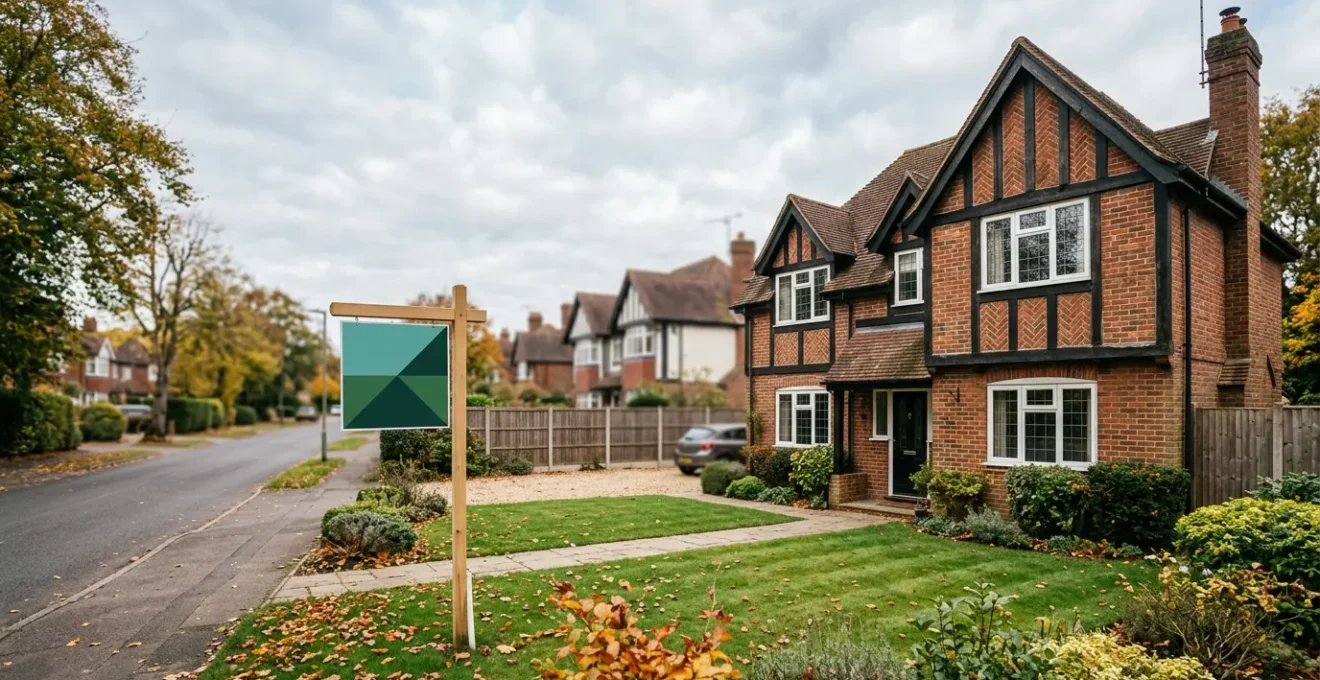
The fierce competition for detached commuter homes isn’t a temporary trend; it’s a structural reality of the English property market driven by a fundamental scarcity of the right kind of housing stock.
- Developer economics overwhelmingly favour building high-density flats over houses, artificially capping the supply of family-sized properties with gardens.
- Intangible assets like school catchment places and shorter commute times are not just perks; they are quantifiable financial values that buyers ‘capitalise’ directly into their offers.
Recommendation: To succeed, buyers must shift their mindset from simple price-per-square-foot comparisons to a strategic analysis of total ownership cost, latent development potential, and the ‘liquidity premium’ of a high-demand asset.
If you’re a family buyer in the home counties, the scene is painfully familiar. A four-bedroom detached house appears on Rightmove on Tuesday. By Wednesday, viewings are fully booked. By Friday, it’s ‘Sold STC’, often for over the asking price. Meanwhile, two-bedroom flats in the same town, even in modern blocks, can linger on the market for months, their prices static or even falling. The common explanation is the post-pandemic “race for space,” but this is a dangerously simplistic view. It fails to explain the sheer velocity of the detached market and the concurrent stagnation of the flat market.
The truth is more complex and far more structural. This isn’t just about buyer preference; it’s about a deep, systemic imbalance between what is being built and what family buyers desperately need. The phenomenon is a direct consequence of decades of planning policy, developer economics, and the unique way English homebuyers value proximity to transport and schools. Understanding these forces is no longer an academic exercise; for anyone hoping to secure a family home in a high-demand commuter location, it is the essential first step to building a winning strategy.
But if the core issue is a fundamental lack of supply, what are the specific mechanisms driving this scarcity? The answer lies not just in the number of homes being built, but in the *type* of homes. This guide will dissect the key economic and social forces that create this two-speed market. We will explore why developers make the choices they do, how to calculate the real value of a commute, and why a school’s Ofsted rating can be worth more than a new kitchen.
By understanding the underlying mechanics of this supply-constrained reality, you can move from being a frustrated participant to a strategic competitor, able to identify true value and act with the speed and conviction this market demands.
Summary: Decoding the Commuter Belt’s Two-Speed Property Market
- Why Are Developers Building Fewer Detached Houses Than 30 Years Ago?
- How Far Out Must You Move to Afford a 4-Bedroom Detached House on a £600,000 Budget?
- M4 Corridor or Thameslink Line: Which Commuter Route Offers Better Detached House Value?
- The £50,000 Unextended House That Became Worth £150,000 More After Permitted Development Conversion
- When to Buy Near Your Target School: Before or After Securing a Place?
- Why Do Properties Within 3 Miles of Weybridge Station Command 25% Premiums?
- Why Do Properties Within School Catchments Appreciate 15% Faster Over Decades?
- Why Does a House in Zone 6 Cost More Per Square Foot Than the Same House 10 Miles Further Out?
Why Are Developers Building Fewer Detached Houses Than 30 Years Ago?
The core of the problem isn’t a lack of overall construction, but a fundamental mismatch in what is being supplied. While the government may point to headline figures of 190,600 new build completions in England in a year, the critical question is: what *type* of homes are these? The reality for family buyers is shaped by simple but brutal developer economics. A developer’s primary metric is profit-per-acre, and on a finite plot of land, it is almost always more profitable to build a high-density block of 50 flats than a low-density development of 10 detached houses.
This economic incentive is compounded by planning policies that have, for decades, prioritised meeting housing targets through high-density schemes, often on brownfield sites. The result is a steady stream of smaller, one and two-bedroom flats entering the market, while the stock of three and four-bedroom detached houses—the most sought-after asset for growing families—remains almost static. This creates a market of structural scarcity for detached homes.
This isn’t just a theory; it’s reflected directly in market performance. The demand-supply imbalance creates a powerful upward pressure on the price of the scarce asset. Crucially, since 2020, detached house prices increased by 30% while flat prices rose only 15%. This divergence is the clearest possible signal of a market where one segment is chronically undersupplied and the other is adequately, or even over-, supplied. For a family buyer, this means you are competing for a product that is not being replenished at a rate that meets demand, a situation that turns every purchase into a competitive auction.
How Far Out Must You Move to Afford a 4-Bedroom Detached House on a £600,000 Budget?
Faced with the structural scarcity of detached homes closer to London, the most common strategy for buyers is to compromise on location. The “go further out” approach seems logical: as distance from the capital increases, prices should fall. While broadly true, this calculation is far from linear. The decision involves a complex trade-off between mortgage costs, commuting time, and season ticket expenses—the total cost of ownership.
A £600,000 budget that is non-competitive in a town like Weybridge or St Albans can become a dominant bid just 20 miles further down the line. However, this saving on the purchase price is immediately offset by increased financial and personal costs. A longer commute doesn’t just mean a more expensive annual rail pass; it means less time with family, more stress, and reduced flexibility. These are the intangible, yet highly significant, costs of the compromise.

As the image above evokes, the daily commute is a central part of the equation, a routine that defines the lifestyle attached to a property. The key for a strategic buyer is to quantify this trade-off precisely. It requires looking beyond the headline property price and analysing the complete financial picture. The table below illustrates how quickly the equation changes based on location, transforming the notion of “affordability.”
This comparison from a recent analysis of London commuter towns demonstrates the stark financial reality. A detached house may be out of reach in Maidenhead, but the same budget is more than sufficient in Peterborough, albeit at the cost of a significantly longer journey and higher annual travel costs.
| Town | Distance from London | Average Detached House Price | Journey Time | Annual Season Ticket Cost | Total First Year Cost |
|---|---|---|---|---|---|
| Maidenhead | 26 miles west | £650,000+ | 21-25 minutes to Paddington | £4,500-£5,000 | £654,500-£655,000 |
| St Albans | 26 miles north | £576,000 | 20 minutes to Kings Cross | £3,800-£4,200 | £579,800-£580,200 |
| Stevenage | 27 miles north-east | £408,333 (semi-detached) | 24 minutes to Kings Cross | £4,000-£4,500 | £412,333-£412,833 |
| Reading | 40 miles west | £362,003 | 30-35 minutes to Paddington | £4,200-£4,800 | £366,203-£366,803 |
| Peterborough | 76 miles north | £242,000 | 50 minutes to Kings Cross | £5,000-£5,500 | £247,000-£247,500 |
M4 Corridor or Thameslink Line: Which Commuter Route Offers Better Detached House Value?
Not all commuter routes are created equal. The economic character of a transport corridor has a profound impact on its property market, creating distinct value profiles. Two prime examples are the M4 Corridor to the west of London and the Thameslink line running north. While both offer fast connections to the capital, the underlying economies of their respective towns dictate very different conditions for house buyers.
The M4 corridor is often dubbed England’s ‘Silicon Valley’. It is a hub of high-value industry, attracting a workforce of high-earning professionals. This creates immense and resilient demand for quality family housing, pushing prices for detached properties to a significant premium compared to towns at a similar distance on other lines. On the other hand, towns along the Thameslink line, while also popular and convenient, may have more diversified local economies, resulting in a slightly less intense concentration of top-tier earners competing for the same limited housing stock.
Case Study: The M4 ‘Silicon Valley’ Effect
The M4 corridor, particularly the area encompassing Reading, Maidenhead, and Slough, serves as the UK headquarters for a host of major technology firms, including Microsoft, Oracle, and Cisco. This concentration of tech-driven employment results in strong economic fundamentals; for instance, Windsor and Maidenhead are projected to see GVA growth of 2.3% annually from 2024-2027, outpacing most of the UK. This powerful economic engine fuels relentless demand for executive family homes, which in turn drives property prices higher than in comparable towns on the Thameslink route that lack such a concentrated, high-income employment base.
This economic strength translates directly into property values. For example, recent property data shows the £362,003 average property price in Reading is already significantly higher than in towns further north at a similar distance from London. For a buyer, this means that a property on the M4 corridor may offer stronger long-term price appreciation due to its robust local economy, but the entry cost is substantially higher and the competition fiercer. Choosing a commuter line is therefore not just a transport decision, but an economic one.
The £50,000 Unextended House That Became Worth £150,000 More After Permitted Development Conversion
In a market defined by the scarcity of finished, family-ready homes, one of the most powerful strategies is to create the space yourself. Buyers who can identify properties with untapped potential can effectively bypass the fiercest competition. The key lies in understanding England’s Permitted Development (PD) rights, a set of regulations that allow homeowners to extend and improve their properties without needing to go through the full planning permission process.
An unextended three-bedroom detached house might be overlooked by families needing four bedrooms immediately. This reduces its buyer pool and, consequently, its price. A strategic buyer, however, sees the potential. By purchasing this property for, say, £50,000 less than a comparable extended house, they can then use PD rights to build a rear extension or a loft conversion. For an outlay of perhaps £70,000, they can add the fourth bedroom and extra living space, creating a property worth £150,000 more in the open market. They have not only acquired the home they need but have also manufactured significant equity.
This strategy requires diligence and an understanding of the rules, as PD rights can be complex and vary by location. They do not apply in the same way to all properties, especially those in Conservation Areas or Areas of Outstanding Natural Beauty (AONB). However, for the right property, this approach is a direct and effective counter-manoeuvre to the structural scarcity of large family homes. It is about buying potential, not just bricks and mortar.
Your Action Plan: Permitted Development Rights Checklist for Detached Houses
- Verify Planning History: Use the local council’s online planning portal to confirm that a property’s Permitted Development rights have not been previously removed or restricted, which can happen on new-build estates.
- Check for Designations: Confirm the property is NOT located in a Conservation Area, National Park, or an Area of Outstanding Natural Beauty (AONB), as these designations severely restrict or remove PD rights.
- Assess Loft Potential: Under PD rights, detached houses can typically add up to 50 cubic metres of volume in a loft conversion without full planning permission, a significant amount of extra space.
- Evaluate Rear Extension Impact: Measure any potential rear extension against the ’45-degree rule’. This ensures your extension does not unacceptably block light from a neighbour’s window, a common point of contention.
- Know Extension Limits: Check the specific limits for single-storey rear extensions. For a detached house, this is typically up to 4 metres, but can be extended to 8 metres under a ‘prior approval’ process.
- Seek Pre-Application Advice: If there is any uncertainty about your plans, obtaining pre-application advice from the local planning authority is a low-cost way to get clarity before committing to a purchase.
When to Buy Near Your Target School: Before or After Securing a Place?
For families with school-age children, proximity to a ‘Good’ or ‘Outstanding’ state school is often the single most important factor in their property search. This creates hyper-localised pockets of intense demand, where being on the right side of a street can add tens of thousands of pounds to a property’s value. A common dilemma for buyers is timing: should you buy within the catchment area before applying, or wait until you have a confirmed school place? The answer, dictated by local authority rules, is unequivocal.
School places are allocated based on the child’s main residence at the time of the application deadline. Waiting to secure a place before buying is therefore not a viable strategy. You must already be a resident within the catchment area to be eligible in the first place. This creates a hard deadline for property transactions, forcing families to complete their purchase months before the January application cut-off for primary schools. This pressure further fuels the competitive nature of the market in these specific areas.

This non-negotiable timeline means that the market for houses in desirable catchments operates on a different calendar from the rest of the property market, with a surge of activity and competition in the summer and autumn. As the UK Government’s admissions framework makes clear, residency is not a negotiable point.
To be eligible for a school place, families must be resident at an address by a specific date (e.g., the application deadline of Jan 15th for primary). This dictates a property purchase completion deadline months in advance.
– Local Education Authority Admissions Policy, UK Government Education and School Admissions Framework
Why Do Properties Within 3 Miles of Weybridge Station Command 25% Premiums?
The premium attached to prime commuter locations like Weybridge is a clear demonstration of “value capitalisation”. Buyers are not just paying for a house; they are paying for a shorter, more convenient journey to London. A 25-minute commute from Weybridge to Waterloo is a tangible, daily benefit, and in a competitive market, that benefit has a specific price tag. The premium reflects the monetary value that thousands of buyers place on saving 40-60 minutes of travel time each day.
This creates a steep “cost-of-distance gradient.” For every minute of commute time saved, the property price increases by a surprisingly predictable amount. The premium isn’t arbitrary; it’s the market’s way of balancing the total cost of housing and transport. A buyer can choose a cheaper house further out, but they will pay for it with a more expensive season ticket and, more importantly, with their time. Conversely, paying the premium for a Weybridge property is, in effect, pre-paying for years of shorter commutes.
This effect is quantifiable across the entire commuter belt. Research consistently shows a direct correlation between journey time and property price. As research from Lloyds Bank demonstrates, the savings are significant: properties in towns just 20 minutes from London offer a 38% saving compared to Zone 2, and this saving grows to 47% for towns a 40-minute journey away. The 25% premium for a location like Weybridge is therefore the precise market price for being on the steep, expensive end of that gradient, where time-saving is valued most highly.
Why Do Properties Within School Catchments Appreciate 15% Faster Over Decades?
The premium for homes in top school catchments is not a one-off payment; it’s an investment that delivers superior long-term returns. The 15% faster appreciation is driven by the persistent and non-negotiable nature of demand. While demand for features like a home office or a large garden can be cyclical, the demand for access to high-quality state education is constant. Every year, a new cohort of families enters the market, all competing for the same limited pool of properties within the catchment boundaries of ‘Outstanding’ schools.
This relentless demand acts as a powerful support for prices during market downturns and an accelerator during upturns. The value of the school place is effectively capitalised into the house price. Buyers are often making a conscious financial calculation: the premium paid for a house in a catchment is often significantly less than the cost of private school fees over the course of a child’s education. This turns the property into a financial tool for accessing a high-value service for free.
Some towns have catchment areas that strongly influence property prices, with homes near Outstanding-rated schools commanding significant premiums as buyers capitalize the value of free education (versus £20,000+ annual private school fees) directly into property purchase prices.
This mechanism ensures that these properties are not just homes but also highly resilient assets. The demand is insulated from wider economic fluctuations. As long as the school maintains its high rating, the property will command a premium and benefit from enhanced appreciation. For a family buyer, this means that paying more for a house in the right catchment isn’t just a lifestyle choice; it’s a sound, long-term financial strategy that provides both educational access and wealth creation.
Key takeaways
- The scarcity of detached houses is not a market whim but a structural issue driven by developer economics favouring high-density flats.
- Premiums for commute times and school catchments are not abstract; they represent the quantifiable, ‘capitalised’ value of time saved and services accessed.
- Success in this market requires moving beyond simple asking prices to a total cost analysis, including travel expenses and the potential for value creation through development.
Why Does a House in Zone 6 Cost More Per Square Foot Than the Same House 10 Miles Further Out?
The idea that a house in Zone 6 could be more expensive per square foot than an identical one further out seems counter-intuitive, but it reveals the final, crucial layers of the commuter belt property market: the total cost of ownership and the liquidity premium. While the headline price of the outer property is lower, its lifetime running costs are higher. As rail fare analysis shows, the financial penalty for distance is severe, with annual season tickets rising from around £2,481 for 20-minute journeys to £5,169 for 60-minute trips.
Over a decade, this difference in commuting cost can amount to over £25,000, a sum that sophisticated buyers mentally subtract from the perceived saving on the more distant property. The Zone 6 house, despite its higher initial price per square foot, may actually be cheaper over the long term once transport is factored in.
Beyond this calculation, however, is a more subtle factor: market liquidity. A property’s value is also a function of how easily it can be sold. A house in Zone 6 is accessible to a much larger and more diverse pool of potential buyers than one 10 or 20 miles further out. This pool includes not just London-centric commuters, but also international buyers, investors, and those who need to be in the capital for non-work reasons. This deep well of demand provides a significant advantage.
A property in Zone 6 has a far larger pool of potential buyers (including international investors, London-focused professionals) than a town further out, meaning it’s typically easier and faster to sell—a valuable feature in a fluctuating market.
– Property Market Analysts, UK Housing Market Liquidity Analysis
Therefore, succeeding in this market requires a fundamental shift in perspective. It means understanding that you are not just buying a home, but competing for a scarce asset class. The winning strategy involves looking beyond the asking price to analyse the hidden value in development potential, the long-term savings of a shorter commute, and the financial security of a property in a top school catchment. By arming yourself with this deeper understanding of the market’s mechanics, you can begin to identify opportunities where others only see obstacles.