
The seemingly endless paperwork for listed building consent isn’t arbitrary bureaucracy; it’s a predictable risk management process. The frustration and delays often stem from a misunderstanding of what a Conservation Officer needs to see to justify an approval. By shifting your mindset from that of a frustrated homeowner to a strategic project manager who understands the principles of heritage significance, you can navigate the system efficiently, minimise delays, and dramatically increase your chances of a first-time approval.
The letter from the council feels like a punchline to a bad joke. Eight months of paperwork, endless forms, and specialist reports, all just to replace a single, draughty window in your Grade II listed cottage. It’s a scenario that breeds frustration, making the planning system feel like an opaque and adversarial force designed to thwart even the most reasonable of home improvements. You look at your neighbour’s house, seemingly identical, and wonder how they managed to get their extension approved while you’re stuck in a bureaucratic quagmire.
The common advice is often unhelpful: “fill in the forms correctly,” or the vague warning that “you need consent for everything.” This approach misses the fundamental point. The system isn’t just a series of hoops to jump through. It operates on a clear, if often unspoken, logic centred on the preservation of ‘special architectural and historic interest’. The delays and rejections aren’t random; they are the result of applications that fail to speak the language of heritage and fail to address the core concerns of the Conservation Officer.
But what if the key wasn’t to fight the system, but to understand its playbook? This guide demystifies the process from the perspective of a consultant who has navigated it over a hundred times. We will not just tell you what the rules are; we will explain the ‘why’ behind them. The goal is to transform your approach from a hopeful request into a well-reasoned, evidence-backed proposal that anticipates questions, mitigates risks, and provides the Conservation Officer with everything they need to say ‘yes’.
By understanding the principles behind decisions on everything from front door colours to modern kitchens, you can proactively manage the process. This article breaks down the core strategies that turn a potentially long and arduous journey into a predictable and successful project.
Summary: Navigating the Complexities of Listed Building Consent in England
- Why Can’t You Change Your Door Colour on a Grade II Property Without Formal Consent?
- How to Write a Heritage Impact Statement That Gets Approved First Time?
- Permitted Development or Full Consent: What Can You Build Without Asking on a Listed Property?
- The uPVC Windows Installed Without Consent That Cost £15,000 to Replace with Timber
- When to Submit Listed Building Consent: Before Planning Application Backlogs Peak?
- How to Get Historic England Approval for a Modern Kitchen in Your Grade II Manor?
- Why Does Being in a Conservation Area Affect Even Your Choice of Front Door Colour?
- Why Did Your Neighbour Get planning permission for an Extension That Was Rejected for Your Identical House?
Why Can’t You Change Your Door Colour on a Grade II Property Without Formal Consent?
The colour of your front door seems like a minor, personal choice. Yet on a listed building, it’s considered an integral part of its character. The control isn’t about personal taste; it’s about preserving the collective ‘special architectural and historic interest’. A jarring, modern colour could detract from the building’s historic aesthetic, and the cumulative effect of such changes across a historic street could erode its character entirely. Conservation Officers are trained to see the building not just as your home, but as a heritage asset where every detail, including the finish of the front door, contributes to its significance.
Therefore, changing the colour requires Listed Building Consent (LBC) because it is an alteration that affects the building’s character. The process forces a homeowner to justify their choice within a heritage context. The good news is that a well-researched application has a very high chance of success. In fact, data from Historic England shows a 93% approval rate for Listed Building Consent applications in 2022/23, proving the system is designed to permit appropriate change, not block it. The key is demonstrating that your proposed colour ‘preserves or enhances’ the character of the building, rather than harms it. This means doing your homework.
Your Action Plan: The Local Provenance Test
- Points of contact: Begin by visiting your local council’s planning department website. Search for documents titled ‘Conservation Area Character Appraisal’ or ‘Design Guide’ specific to your location to understand the official local guidance.
- Collecte: Within these documents, locate the section on historic colour palettes. Many councils specify colours that are historically appropriate for different regions or building types, providing you with a pre-approved range of options.
- Cohérence: Access your property’s official description on the National Heritage List for England. Identify the specific ‘special architectural and historic interest’ elements to understand what makes your property significant and ensure your choice is consistent with its character.
- Mémorabilité/émotion: If proposing a non-traditional colour, use the council’s planning portal to find precedent from other approved LBC applications in your area. This helps you build a case based on ‘enhancement’ rather than simple change.
- Plan d’intégration: Formulate your proposal as a well-researched decision. Demonstrate that you have considered the context, the property’s unique history, and how the new colour will complement, not detract from, its heritage value.
How to Write a Heritage Impact Statement That Gets Approved First Time?
The Heritage Impact Statement (HIS), sometimes called a Heritage Statement or Statement of Significance, is the single most important document in your application. It is your opportunity to make the case for your project. A poor statement simply describes the work, whereas a great one explains the ‘why’ from a heritage perspective. It demonstrates to the Conservation Officer that you understand what is significant about your property and have designed your project to minimise harm to that significance. It is not just paperwork; it is the central pillar of your argument.
Thinking like a consultant means seeing the HIS as your primary tool for de-risking the application. A thorough, well-structured statement preempts the Officer’s questions and provides them with the written justification they need to approve your plans. The key is to move beyond a simple description of “what I want to do” and instead provide a detailed analysis of the building’s history, the impact of the works, and the methods you will use. This shows respect for the process and the property’s history, immediately setting your application apart from less considered proposals.
To structure this critical document, you can use a framework that covers all the essential points. The ‘PAST Principle’ is a straightforward way to ensure your statement is comprehensive and persuasive.

A successful Heritage Impact Statement is built on meticulous research and clear justification, as the detailed documentation of historic materials here suggests. It should follow a clear structure:
- P – Provenance: Detail the building’s history and significance. Research your property’s listing entry, historical maps, and local conservation area appraisals to establish context.
- A – Alteration: Clearly describe the proposed work with annotated photos showing exactly what will be affected. Include elevations, floor plans, and precise specifications.
- S – Significance: Assess the impact on the ‘historic fabric’ (the original materials of the building). Justify why any harm is minimal or necessary, and why the benefits of the proposal outweigh that harm.
- T – Treatment: Detail the materials and methods you will use. Including quotes from specialist craftsmen proves your intention to carry out the work to a high standard, reassuring the officer about the quality of the execution.
Permitted Development or Full Consent: What Can You Build Without Asking on a Listed Property?
This is a trap many homeowners fall into. For a normal property, ‘Permitted Development’ (PD) rights allow for a range of minor works without a full planning application. For a listed building, these rights are almost entirely removed. The starting assumption must be that any work which alters the character of the building, internally or externally, requires Listed Building Consent. This includes seemingly minor works like replacing a bathroom, moving an internal door, or even repainting previously unpainted brickwork.
The common refrain of “‘like-for-like’ repairs don’t need consent” is dangerously oversimplified. A true like-for-like repair uses the same materials and methods as the original. Replacing a small, rotted section of a timber window frame with new, identical timber is a repair. Replacing the entire window, even with a timber replica, is an alteration and requires consent. The distinction is subtle but critical, and getting it wrong can lead to enforcement action. This confusion is compounded by the fact that, as Historic England data reveals, there has been a 36% reduction in conservation officer posts since 2006, meaning officers have less time to provide informal advice, making formal clarification more important than ever.
Case Study: The Certificate of Lawfulness as a Risk Mitigation Strategy
For absolute certainty, the only risk-free method is to apply for a ‘Certificate of Lawfulness of Proposed Works’. This formal process asks the council to legally confirm whether LBC is required for your specific project. According to guidance from councils like South Gloucestershire Council, this is a smart investment to avoid future legal action. The process typically costs around half the fee of a full planning application and is usually completed within 8 weeks. It provides legal certainty; if the council issues a certificate confirming consent isn’t needed, you are protected from any future enforcement, even if interpretations of the rules change.
The uPVC Windows Installed Without Consent That Cost £15,000 to Replace with Timber
The consequences of carrying out unauthorised work on a listed building are not just theoretical; they are financially severe. Installing inappropriate uPVC windows is one of the most common breaches, and the subsequent enforcement action serves as a stark warning. When the local authority discovers such a breach, they will serve an enforcement notice requiring the owner to remove the offending windows and reinstate appropriate, historically accurate replacements at their own cost. This is not a negotiation; it is a legal requirement.
The financial penalty extends far beyond the simple cost of replacement. It creates a “double-spend” scenario where the money spent on the illegal work is completely wasted. Furthermore, a property with an active enforcement notice against it becomes virtually unsaleable and un-mortgageable. Lenders will not provide finance for a property with an unresolved legal issue, trapping the owner until the situation is rectified. The process can take months or even years, incurring additional legal fees and causing immense stress.
Case Study: The True Cost of an Enforcement Notice
A recent case involving a Georgian terrace highlights the cascading financial impact. An owner installed uPVC windows without consent. The subsequent enforcement notice required their complete removal and replacement with bespoke timber sash windows. According to a report on the case, the total cost was far more than the initial £15,000 estimate often quoted. The breakdown included: the original £8,000-£12,000 wasted on the uPVC windows, a staggering £35,000 for the correct timber replacements, council enforcement fees of several thousand pounds, and significant legal fees to manage the process. The total financial damage, including the property’s devaluation during the dispute, can easily exceed £50,000, turning a misguided shortcut into a financial catastrophe.
When to Submit Listed Building Consent: Before Planning Application Backlogs Peak?
Submitting your application is not just about what you submit, but also when. Planning departments, like any organisation, have peak periods and quieter times. A frustrated homeowner might send their application the moment it’s ready, but a strategist considers the calendar. Submitting during a major rush means your application is one of a huge pile on an overworked officer’s desk. They will have less time for constructive dialogue, pre-application queries, or negotiating minor amendments. An application that might have been approved with minor tweaks could be refused simply due to a lack of officer capacity to engage.
While local planning authorities like Bristol Council state a statutory period of 8 weeks for a decision on standard applications (and 13 for major ones), this is a target, not a guarantee, especially during peak times. Understanding the annual workflow of a planning department allows you to time your submission strategically to maximise the attention your file will receive.
A consultant’s approach involves targeting the quieter months to improve the chances of smooth and constructive engagement. Consider this strategic calendar for your submission:
- Avoid the Pre-Summer Rush: May and June are often the busiest months as people rush to get approvals for summer building work. Your application risks being lost in the noise.
- Avoid the Christmas Deadline Dash: October and November see another surge as applicants try to secure decisions before the holiday shutdown. Officer feedback can become rushed.
- Target Quieter Months: February and September are often ideal submission windows. Officers may have cleared their backlogs and have more capacity for detailed consideration of new applications.
- Use Pre-Application Advice: This is a paid service (costs vary by council, from £200 to over £1,500) where you can discuss your plans with an officer before formal submission. It’s an invaluable tool for de-risking your application and getting early buy-in on your approach.
- Research Council Performance: Before submitting, use your council’s online planning portal to review recent LBC decisions. Analyse their average decision times and read the officer’s reports to understand what arguments they find persuasive.
How to Get Historic England Approval for a Modern Kitchen in Your Grade II Manor?
The idea of installing a sleek, modern kitchen in a historic manor house seems like a contradiction that would be instantly rejected. However, this is a common desire, especially as over 91.7% of all listed entries are Grade II, many of which are lived-in family homes. The key to gaining approval is not to try and mimic historic styles, which often results in a pastiche, but to propose a modern intervention that is honest, high-quality, and, crucially, ‘reversible’.
The guiding principle is to ensure that your new kitchen does minimal or no harm to the ‘historic fabric’ of the room. This means the original floors, walls, windows, and ceiling features should be left untouched. The solution favoured by Historic England and conservation officers is the ‘box within a box’ concept. Your modern kitchen should be designed as a freestanding element, almost like a piece of furniture, that sits within the historic room without being permanently fixed to its sensitive surfaces. This approach creates a clear and respectful distinction between old and new.
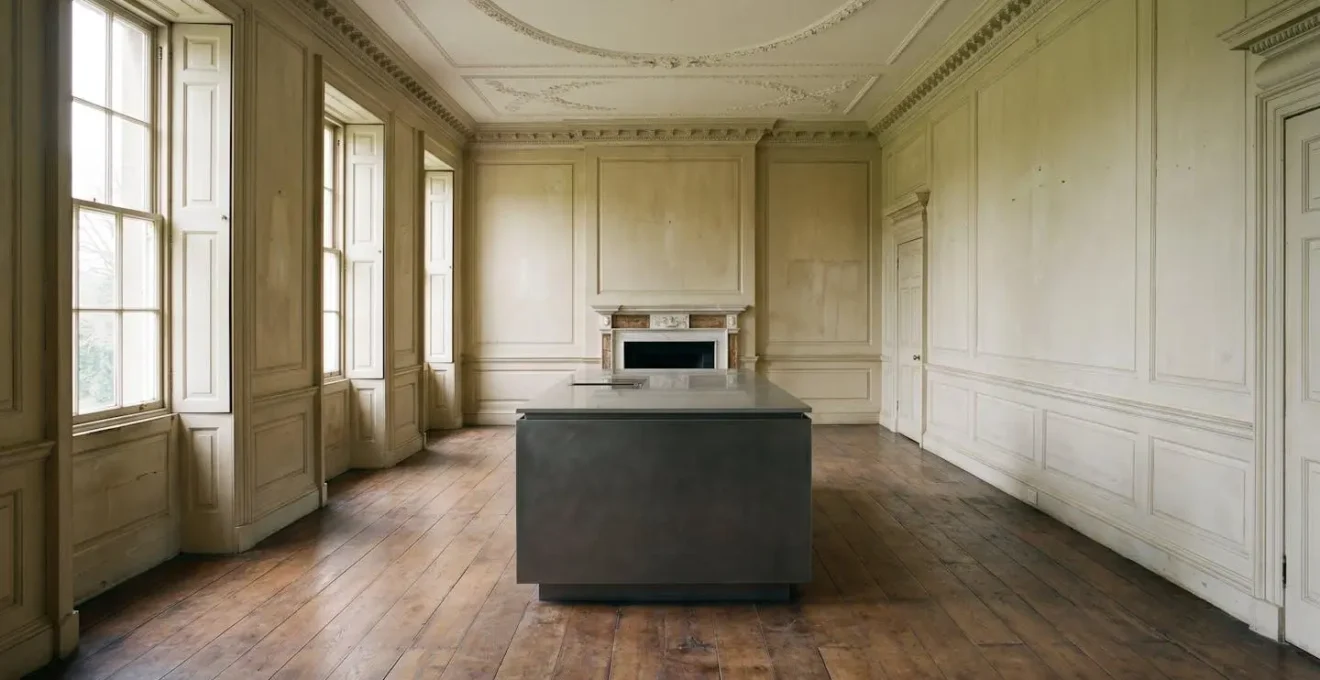
As this image demonstrates, a modern intervention can coexist beautifully with a historic interior. A freestanding kitchen island contains all the modern services, but it doesn’t touch the original panelled walls or ornate plasterwork. The modern units are clearly of their time, and crucially, if they were to be removed in the future, the historic room would be left in its original state. This concept of reversibility is paramount. Your Heritage Impact Statement must clearly articulate this strategy, explaining how the installation will be carried out without chasing walls, cutting into original floors, or damaging any part of the building’s significant fabric.
Why Does Being in a Conservation Area Affect Even Your Choice of Front Door Colour?
Living in a Conservation Area introduces a layer of control that can be confusing, especially when your property is not itself listed. A Conservation Area is designated because it has a special architectural or historic character that is desirable to preserve. The focus is on the ‘group value’ – the overall appearance and feel of the streetscape, not just individual buildings. Therefore, controls are in place to manage changes that could, cumulatively, erode that character. Your front door colour, window style, and even the type of satellite dish you install can all be subject to control.
The primary tool used to enforce these controls is an ‘Article 4 Direction’. This is a legal order made by the council that removes specific Permitted Development rights within the designated area. For example, an Article 4 Direction can remove your right to change windows or doors on elevations visible from the road without first obtaining planning permission. This gives the council the power to vet these changes to ensure they are in keeping with the area’s character.
Case Study: How Article 4 Directions Work in Practice
The London Borough of Camden provides a clear example of this. In conservation areas like Hampstead and Belsize, they have implemented Article 4 Directions that specifically remove PD rights for changes to windows, doors, and the painting of facades. This means a homeowner who could previously have changed their front door without consent now needs to apply for planning permission. The aim is to prevent the piecemeal loss of historic features which, taken together, define the character of these historic neighbourhoods.
It’s crucial to understand that Conservation Area controls are different and generally less stringent than those for a Listed Building. The following table, based on guidance from a recent analysis from Historic England, clarifies the key distinctions.
| Element | Listed Building Controls | Conservation Area Controls |
|---|---|---|
| Roof alterations | LBC needed for any change affecting character | Planning permission may be needed for material changes |
| Windows & Doors | LBC needed for replacement or alteration (internal & external) | Planning permission needed if Article 4 Direction applies to elevations facing public highways |
| External painting | LBC needed if previously unpainted or colour affects character | Controlled by Article 4 Direction in some areas for previously unpainted buildings |
| Trees | Tree Preservation Order (TPO) procedures apply | 6 weeks’ notice required before works to trees (Conservation Area notification) |
| Demolition | Listed Building Consent required | Conservation Area Consent needed for demolition of buildings/structures |
| Extensions | LBC needed for any extension affecting character; Permitted Development rights heavily restricted | Permitted Development rights more restricted than standard; Article 4 can remove further rights |
| Interior works | LBC needed if affecting special interest (both internal & external) | No additional controls on interior unless building also listed |
Key Takeaways
- The Listed Building Consent process is not arbitrary; it follows a logic based on preserving ‘heritage significance’.
- Success depends on providing a well-researched justification (the Heritage Impact Statement) that anticipates a Conservation Officer’s concerns.
- Unauthorised work leads to severe financial and legal consequences, far exceeding the cost of doing things correctly from the start.
- Strategic timing and using tools like pre-application advice can significantly de-risk the process and improve outcomes.
Why Did Your Neighbour Get planning permission for an Extension That Was Rejected for Your Identical House?
This is perhaps the most frustrating scenario a homeowner can face. You see an approval for an extension on a seemingly identical house down the road, you submit a similar plan, and you receive a rejection. It feels arbitrary and unfair, feeding the perception that planning decisions are a lottery. The reality is that while subjectivity plays a part, there are often concrete, if hidden, variables that explain the different outcomes. Understanding these variables is the final step in moving from a frustrated applicant to a strategic player.
The planning system is not static. Policies evolve, precedents are set, and individual circumstances differ in subtle but crucial ways. What was approved five years ago may not be acceptable today. Your neighbour’s success does not guarantee your own. A consultant’s job is to investigate these differences and build a case that addresses the specific context of *your* property at *this specific moment in time*. A rejection is often not a final ‘no’, but an indication that your application has failed to adequately address one of these hidden variables.
According to legal experts in planning law, several factors can lead to these inconsistent outcomes. Before assuming unfairness, consider these five hidden variables that commonly influence planning decisions:
- The Policy Timing Variable: Planning policy is not fixed. Your neighbour may have applied under an older, more lenient Local Plan. A new plan or supplementary guidance may have been adopted since, introducing stricter rules on massing, materials, or design that now apply to your application.
- The Negative Precedent Variable: Your neighbour’s approval might have been a mistake. If the council received complaints or subsequently decided that the extension caused harm to the area’s character, they may now be actively refusing similar applications to prevent what they see as further damage.
- The Officer Subjectivity Variable: While guided by policy, different Conservation Officers can have different interpretations of ‘harm’ or ‘enhancement’. One may prioritise the scale of an extension, while another focuses more on the material details. The individual officer assigned to your case is a significant variable.
- The Application Quality Variable: Your neighbour might have submitted a far superior application. A proposal backed by a detailed Heritage Impact Statement, extensive historical research, and clear architectural drawings prepared by a specialist architect is much more persuasive than a basic submission, as analysis from Burges Salmon points out.
- The Micro-Context Variable: No two houses are truly identical in planning terms. Your property might occupy a more prominent corner plot, be more visible from a key public viewpoint, or retain a specific original feature that your neighbour’s has lost, giving it a higher heritage significance and making it more sensitive to change.
To put these principles into practice, your next step is to approach your project not as a simple building task, but as the strategic management of your property’s unique heritage. By understanding the process, respecting the fabric of your home, and presenting a well-reasoned case, you can turn a source of frustration into a successful and rewarding endeavour.