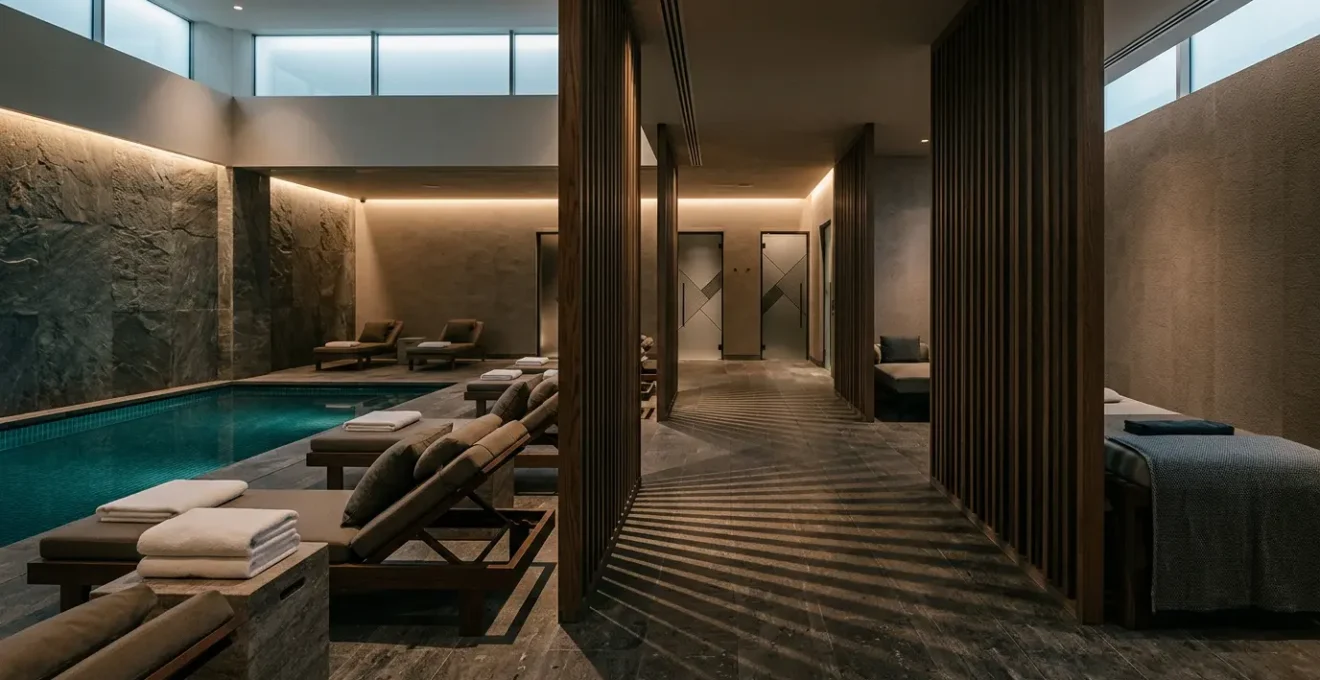
A basement spa is a niche asset that narrows the buyer pool, making the property a high-reward but low-liquidity investment.
- The value uplift is only realised from a small segment of the market willing to pay a premium for a high-maintenance, specialist amenity.
- Longer sale times are a direct result of this reduced buyer pool, as the property must wait for the “right” purchaser who values the feature and accepts the associated costs.
Recommendation: Success is not about adding the amenity, but about meticulously de-risking the project’s construction, operational, and resale liabilities to protect the net return on investment.
For high-net-worth homeowners in England, the decision to install a basement spa or wellness suite is often framed as a straightforward value-add. Property advisors tout the lifestyle benefits and potential capital appreciation. Yet, this overlooks a critical market paradox: while these bespoke amenities can command a price premium, they simultaneously extend the time a property spends on the market. The common advice focuses on personal enjoyment or generic notions of “adding value,” but rarely dissects the complex financial mechanics at play.
The conversation often revolves around design aesthetics and initial build costs. However, the true financial picture is far more nuanced, encompassing overlooked liabilities like catastrophic damp, exorbitant running costs, and the strategic mis-timing of regulatory approvals. These are not minor details; they are the factors that can turn a perceived asset into a significant financial drain. The core issue isn’t whether a spa adds value, but how to calculate its net amenity value after all risks and costs are factored in.
But what if the key to a successful wellness installation wasn’t simply its existence, but the rigorous de-risking of its every component? This analysis moves beyond the glossy brochures to provide an investor’s perspective. We will dissect the underlying drivers of cost, risk, and return, exploring why many home gyms gather dust, how to prevent six-figure damp damage, and how to specify technology that high-value insurers will actually recognise. This is a guide to sizing the buyer pool and understanding the trade-off between a higher asking price and market liquidity.
This article provides a structured analysis of the key financial and technical considerations for luxury homeowners. By breaking down the investment into its core risk components, you can make a more informed decision on whether a wellness facility is a wise addition to your property portfolio.
Summary: The Financial Realities of Luxury Wellness Amenities
- Why Do 70% of Home Gym Owners Use Their Equipment Less Than Once Monthly?
- How to Prevent £50,000 of Damp Damage When Installing a Basement Swimming Pool?
- Garden Wellness Pavilion or Basement Spa: Which Delivers Better ROI on a £200,000 Budget?
- The £800/Month Energy Bill for a Heated Pool That Gets Used Twice a Year
- When to Apply for Building Regs Approval: Before Detailed Design or After Contractor Selection?
- The Kensington Iceberg Basement That Went £800,000 Over Budget Due to Unforeseen Ground Conditions
- How to Install Fingerprint Entry Systems in a Georgian Townhouse Without Visible Technology?
- How to Secure a £5 Million Property with Technology That Insurers Actually Recognise?
Why Do 70% of Home Gym Owners Use Their Equipment Less Than Once Monthly?
The allure of a home gym or wellness space is potent, driven by an aspirational vision of convenience and health. Indeed, the initial intent is strong; according to 2021 UK consumer survey data, around 74% of consumers owned a home fitness product. However, the gap between aspiration and reality is a significant financial risk. When a high-capital-cost amenity goes unused, it transitions from an asset to a liability, occupying valuable space without delivering its intended lifestyle or investment return. This underutilisation is a key indicator of a feature that may not be valued by a future buyer.
This phenomenon is central to the concept of Buyer Pool Sizing. While a bespoke, high-specification basement spa or gym is a powerful draw for a very specific type of buyer, it can be a significant deterrent for others. Analysis of London’s “iceberg homes” shows that while these unique amenities define a property’s luxury positioning, their niche nature inherently narrows the target market. A potential buyer might see a gym not as a bonus, but as a space they would need to spend money repurposing.
Therefore, the investment question is not “is a gym a good feature?” but “does the size of the buyer pool that values this specific gym justify the capital outlay and the potential increase in sale time?” A rarely used gym signals a mismatch between the property’s features and the owner’s lifestyle—a red flag that a savvy buyer’s surveyor will note. The longer selling time for such properties is the market’s way of waiting for a buyer whose lifestyle perfectly matches the amenity, and who is willing to pay the premium for it. For everyone else, it’s just a basement room with expensive, dusty equipment.
How to Prevent £50,000 of Damp Damage When Installing a Basement Swimming Pool?
The single greatest technical and financial risk in any subterranean construction is water ingress. A leaking basement pool is not a simple repair; it’s a catastrophic failure that can lead to structural damage, health-hazardous mould, and astronomical remediation costs that easily eclipse the initial installation error. The starting point for this investment is understanding the cost of getting it right, with specialist waterproofing which industry estimates show can cost £100-£120/m². This is not a cost to be minimised but an investment to be guaranteed.
The key to liability de-risking is an approach known as Insurability-Driven Specification. This means that design choices are dictated not by minimum standards, but by what high-value property insurers demand. For subterranean structures in the UK, this is governed by BS 8102:2022, which outlines the grades of protection. For a habitable space with a pool, a single waterproofing system is non-compliant and uninsurable. A robust, hybrid solution is non-negotiable.

As the technical cross-section suggests, a compliant system is a multi-layered defence. This typically involves combining different methods: Type A (a barrier membrane), Type B (waterproof concrete admixture), and Type C (a drained cavity system). The goal is redundancy. If one system is compromised, the others provide continuous protection. Engaging a waterproofing specialist with professional indemnity insurance early, at RIBA Stage 2 or 3, is crucial for designing a system that is not only effective but also warrantied and recognised by insurers, thereby protecting the property’s long-term value and saleability.
Garden Wellness Pavilion or Basement Spa: Which Delivers Better ROI on a £200,000 Budget?
When considering a £200,000 wellness investment, a homeowner is faced with a critical choice: excavate a basement or build a garden pavilion? While a basement spa offers ultimate privacy and integration, it comes with a significantly higher cost profile and construction risk, where the construction of garden basement extensions typically ranges from £200,000 to £575,000. A garden pavilion, by contrast, may offer a more predictable and financially efficient route to a similar lifestyle outcome. The decision hinges on a clear-eyed analysis of the Net Amenity Value of each option.
A direct comparison reveals the stark trade-offs between the two approaches. The following analysis breaks down the key financial factors beyond the initial sticker price, including planning complexity, tax implications, and future market appeal.
| Factor | Garden Wellness Pavilion | Basement Spa |
|---|---|---|
| Construction Cost (£200k budget) | £20,000-£60,000 (bespoke high-end) | £200,000-£575,000 (full build) |
| Planning Permission | Often Permitted Development (easier) | Full planning application required |
| VAT Treatment | Some components may avoid 20% VAT | Full 20% VAT on construction |
| Repurposing Flexibility | High (office, annex, gym) | Low (specialist wellness use) |
| Target Buyer Appeal | Broad market appeal | Narrow niche market |
| Council Tax Impact | Moderate VOA reassessment | Significant VOA reassessment |
The data clearly indicates that from a pure ROI perspective, the garden pavilion is the superior financial instrument. Its lower build cost, simpler planning process, and high repurposing flexibility appeal to a much broader buyer pool. A future owner can easily envision it as a home office, a teen den, or an art studio. The basement spa, while luxurious, is a specialist feature that locks the space into a single use, significantly narrowing its appeal and contributing to longer sale times. The Valuation Office Agency (VOA) is also likely to reassess a property with a new basement level more aggressively for council tax purposes than one with an outbuilding. For the investor-minded homeowner, the garden pavilion presents a lower-risk, higher-liquidity option.
The £800/Month Energy Bill for a Heated Pool That Gets Used Twice a Year
Beyond the capital cost of installation, the operational expenditure of a wellness facility is a critical and often underestimated liability. A heated basement pool, in particular, can become a financial black hole if not specified correctly. Anecdotally, with UK pool owner experience suggesting costs of £300/month for outdoor pools just during the summer, a poorly insulated indoor pool can easily double or triple that figure year-round. This fixed running cost directly impacts the property’s marketability, as any prospective buyer will factor it into their affordability calculation. An £800/month energy bill for a rarely used amenity transforms it from an asset into an expensive burden.
However, this liability can be aggressively de-risked through intelligent specification at the design stage. The choice of heating system is the single most important decision. A direct comparison between a standard electric heater and a modern air source heat pump illustrates the scale of the opportunity. According to analysis by 1st Direct Pools, heating a standard UK pool for a season costs approximately £1,909 with an electric heater versus just £402 with a heat pump. This dramatic difference is due to efficiency: a heat pump operates at around 400% efficiency (transferring heat) while an electric heater is only 92% efficient (creating heat).
While the upfront investment for a heat pump system is higher (£15,000-£25,000), the payback period is typically only 3-5 years through energy savings. For a luxury property, specifying this technology is not an upgrade; it is a fundamental requirement for creating a responsible and marketable asset. It demonstrates foresight and transforms the narrative from “this pool is expensive to run” to “this pool has been engineered for maximum efficiency.” This is a powerful selling point that widens the buyer pool to include those who are both luxury-minded and financially astute.
When to Apply for Building Regs Approval: Before Detailed Design or After Contractor Selection?
Navigating the UK’s planning and regulatory system is a critical path for any basement project, but the focus is too often on *if* approval is granted, rather than the strategic *timing* of the application. Applying for Building Regulations approval is not a single event but a process. The decision of when to engage with building control—either the local authority or an Approved Inspector—has significant implications for de-risking the project’s structural and waterproofing strategy. Submitting too late can lead to costly redesigns, while submitting too early with incomplete information can cause delays.
The conventional wisdom is to finalise a design and then seek approval. However, a more robust, investment-led approach involves a sequenced engagement designed to mitigate risk at every stage. For a high-value project like a basement spa, a ‘Full Plans’ application is the only sensible route, providing the legal certainty that the proposed design is compliant before work begins. Using a contractor’s ability to navigate this process with the local authority should be a key evaluation criterion during the tender process.
This strategic sequencing ensures that by the time you break ground, the major technical and regulatory risks have already been designed out of the project, protecting your investment and timeline. Rushing to the construction phase without this structured approval process is a common cause of budget overruns and disputes.
Your Action Plan: Strategic Building Regulations Application
- Early Inspector Engagement: Appoint an Approved Inspector or engage with Local Authority Building Control during RIBA Stage 2-3, well before contractor selection, to de-risk the core structural and waterproofing strategy.
- Define Application Strategy: Opt for a ‘Full Plans’ application over a ‘Building Notice’. This provides comprehensive pre-approval and legal protection, which is non-negotiable for a project of this complexity and value.
- Prioritise Neighbourly Protocol: In dense urban areas like London, the Party Wall Act 1996 process must be initiated and ideally concluded *before* a meaningful Building Regulations submission, as agreements may necessitate design changes.
- Vet Contractor Capabilities: Make the contractor’s demonstrated experience and ability to successfully navigate a ‘Full Plans’ application with the specific local authority a key criterion in your tender evaluation and selection.
- Conduct Pre-Submission Audit: Before formal submission, hold a final review with your design team and inspector to confirm that all key risk areas, especially waterproofing and structural supports, are fully resolved on paper to prevent costly post-approval amendments.
The Kensington Iceberg Basement That Went £800,000 Over Budget Due to Unforeseen Ground Conditions
The most spectacular budget overruns in London basement construction are almost always rooted in the ground itself. The cautionary tale of a Kensington project escalating by £800,000 due to unforeseen ground conditions is not an outlier but a stark reminder of subterranean risk. The primary cause? An inadequate initial assessment of the site’s geology. London’s ground is a complex patchwork of perched water tables, historic river channels like the lost River Westbourne, and variable soil types. Assuming the ground is uniform is a multi-million-pound gamble.
De-risking this starts with investing in proper intelligence. While a basic soil analysis is standard, an “iceberg” basement demands a far more rigorous approach. For these projects, comprehensive geotechnical and hydrogeological investigations… typically cost between £20,000 and £50,000. This may seem like a high upfront cost, but it is fractional compared to the potential cost of an emergency redesign, specialist underpinning, or permanent pumping solutions required when a high water table is discovered mid-excavation.

As this visualisation of subsurface strata implies, what happens below ground is complex and invisible. Even under a “fixed-price” JCT Design & Build contract, clauses for unforeseen geological conditions often exist, meaning this risk can be passed back to the homeowner. The £20k-£50k investigation is not a cost; it is an insurance policy. It provides the structural engineer with the precise data needed to design the correct retaining and waterproofing systems from the outset, effectively eliminating the single largest cause of catastrophic budget overruns and turning an “unknown” into a managed parameter.
How to Install Fingerprint Entry Systems in a Georgian Townhouse Without Visible Technology?
Integrating modern technology into a period property, especially a Grade I or II listed building in England, presents a unique challenge. The goal is to provide state-of-the-art convenience and security without compromising the historical fabric and aesthetic that define the property’s value. For a luxury homeowner, visible plastic sensors, clumsy wiring, and modern control panels are unacceptable. The key principle governing any intervention is reversibility; English Heritage guidelines mandate that all additions must be removable without leaving a permanent trace on the historic structure.
Achieving this “invisible tech” requires a blend of artisan craftsmanship and specialist technical knowledge. It is not about buying off-the-shelf products but commissioning bespoke solutions. This is where costs can escalate if not planned, but also where true luxury is expressed. The process must be undertaken in close consultation with a Conservation Officer from the outset to ensure compliance and avoid costly enforcement action.
Successful integration relies on a set of specific, conservation-approved techniques:
- Custom Housings: Concealing modern sensors within custom-made bronze or brass housings that are designed to mimic period-correct ironmongery.
- Bespoke Joinery: Embedding fingerprint readers or keypads seamlessly into timber wall panelling, architraves, or even custom-carved stone plinths so they are flush and almost unnoticeable.
- Hidden Wiring: Routing micro-cabling along discrete mortar lines or through existing voids. This is often more acceptable to conservation officers than wireless systems which can raise concerns about battery replacement and future obsolescence.
- Material Mimicry: Using specialist painters and artisans to disguise sensors or small cameras on complex surfaces like ornate plasterwork or stonework.
This approach transforms the technology from a potential eyesore into a secret, perfectly integrated feature, preserving the building’s soul while providing 21st-century functionality. It is a prime example of how a significant investment, when executed with expertise, adds value that is both practical and enhances the property’s unique character.
Key Takeaways
- A basement spa is a niche asset that increases value for a select few but reduces market liquidity by narrowing the buyer pool.
- The true cost includes not just construction but also long-term running costs, maintenance, and the financial impact of a longer sale period.
- Success depends on proactive de-risking: investing in comprehensive geotechnical surveys, specifying insurable multi-system waterproofing, and choosing energy-efficient systems.
How to Secure a £5 Million Property with Technology That Insurers Actually Recognise?
For a high-value property, a security system serves a dual purpose: deterring threats and satisfying the stringent requirements of specialist insurers like Hiscox or Chubb. A failure on the second point can be as costly as a failure on the first, potentially invalidating a policy when it’s needed most. The market is flooded with “smart” security gadgets, but from an insurer’s perspective, the brand of the camera is irrelevant. What matters is certification, monitoring, and response.
The gold standard in the UK is a system installed and maintained by a company holding NSI Gold or SSAIB certification. This is non-negotiable. This certification is a guarantee that the installer is competent, the system is correctly specified, and it qualifies for a guaranteed police response (via a Unique Reference Number). Without this, a system is merely a deterrent; with it, it becomes an insurable asset that can lead to significant premium reductions.
Insurers for properties valued at £5 million and above demand a multi-layered security model. Relying on a single technology is a critical mistake. A compliant system includes:
- Perimeter: Analytics-driven PIR beams or ground-loop detectors to create an early warning line.
- Shell: EN 50131 graded sensors on all accessible windows and doors to detect a breach of the building’s envelope.
- Interior: A combination of motion sensors, break-glass detectors, and panic buttons.
- Safe Room: A reinforced room providing a secure refuge, often a mandatory requirement.
- Professional Response: A contract with a certified keyholding company that can guarantee attendance within 20 minutes of an alarm is often a specific policy condition for London properties.
The insurer’s discount structure is tied to the completeness of this model, not the price of the components. Investing in a non-certified, DIY “smart” system is a false economy that provides a poor security outcome and zero financial recognition from the organisations that underwrite the property’s value.
Ultimately, a basement wellness facility should be approached not as a lifestyle purchase but as a complex, private equity-style investment in your own property. The potential for a price premium is real, but it is intrinsically linked to a longer, less certain path to sale. To navigate this paradox successfully, the focus must shift from simply adding a feature to strategically creating a de-risked, efficient, and insurable asset. Your next step is to commission a professional feasibility study that models the costs, risks, and potential ROI for your specific property before committing significant capital.