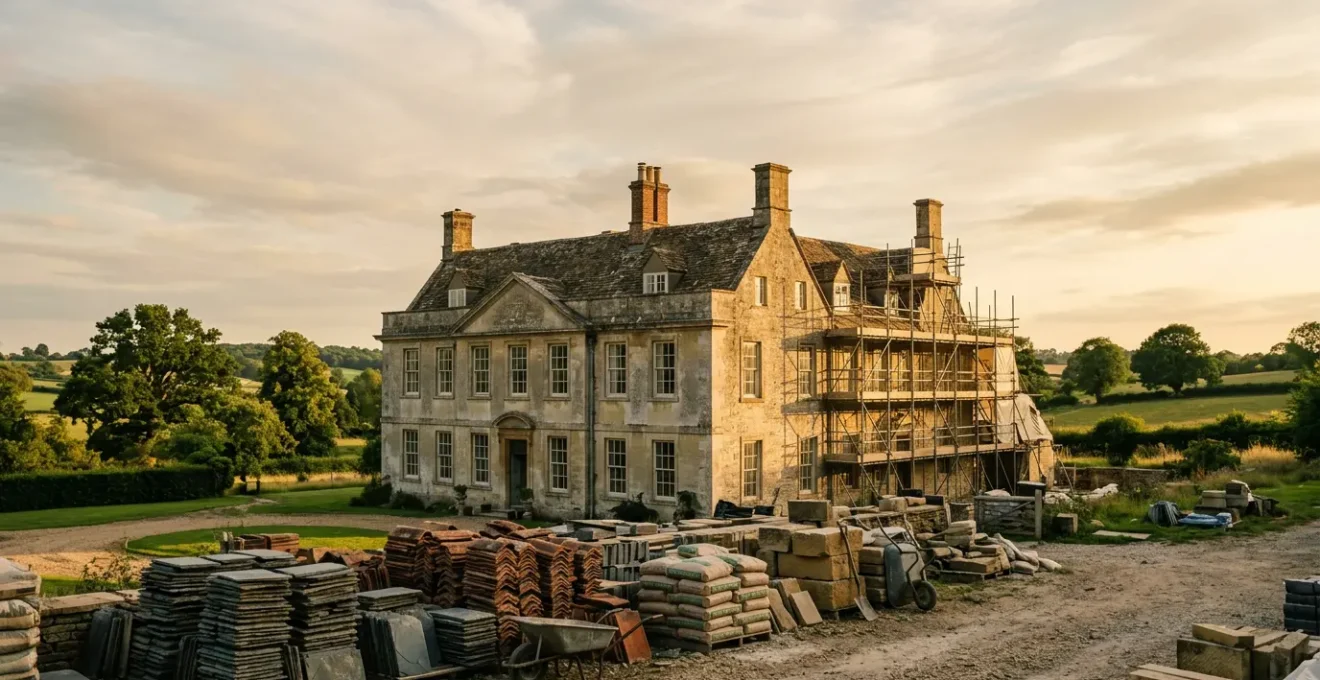
The single biggest financial risk in restoring a listed manor isn’t the cost of materials, but the cost of a rejected application—a risk you can strategically manage.
- Approval hinges on understanding ‘heritage significance’ and proving your changes respect it, not just on following rules.
- Modern interventions, like new kitchens, are possible, but only if they are demonstrably ‘reversible’ and don’t harm the historic fabric.
Recommendation: Before falling in love with the property, fall in love with its history and listing details—this is your primary tool for negotiation and planning.
The allure of owning a piece of English history—a sprawling Grade II* listed manor with centuries of stories etched into its walls—is a powerful dream. For many, it represents a chance to become a custodian of national heritage. But this dream is often shadowed by a potent fear: the intimidating world of listed building constraints, council bureaucracy, and horror stories of renovation budgets spiralling out of control after a single rejection from a Conservation Officer. You’ve likely been told the generic advice: “hire specialists” and “expect it to be expensive.”
While true, this advice is incomplete. It positions the owner as a passive participant, waiting for verdicts from architects and planners. The reality is that the most successful restorations are led by informed clients who understand the ‘why’ behind the regulations. The key to avoiding the £200,000 trap isn’t just about having a bigger budget; it’s about learning to speak the ‘language’ of conservation. It’s about understanding what ‘heritage significance’ truly means for your property and how to frame your vision in a way that aligns with, rather than fights against, preservation principles.
This guide moves beyond the platitudes. It provides a strategic framework for de-risking your investment, not by finding loopholes, but by empowering you to become a proactive, knowledgeable partner in your property’s future. We will demystify the costs, decode the approval process, and reveal the fundamental principles that govern the restoration of England’s most precious homes. By the end, you’ll understand how to protect both the building’s character and your financial well-being.
To navigate this complex but rewarding journey, this article breaks down the essential knowledge you need. Explore the key areas below to build your confidence and strategy before you even make an offer.
Summary: Navigating the Restoration of a Listed English Manor
- Why Does Repairing Your Listed Manor’s Roof Cost Triple a Standard Property?
- How to Get Historic England Approval for a Modern Kitchen in Your Grade II Manor?
- Grade I or Grade II: Which Listing Level Allows More Flexibility for Residential Improvement?
- The Victorian Extension Built Without Consent That Cost the New Owner £80,000 to Regularise
- When to Buy a Listed Manor: Before or After Applying for Historic England Repair Grants?
- How to Write a Heritage Impact Statement That Gets Approved First Time?
- Why Does Your Victorian House Have Damp Walls Despite No Visible Leaks?
- Why Does Your Victorian Terrace Need £30,000 of Damp Work That Modern Houses Don’t Require?
Why Does Repairing Your Listed Manor’s Roof Cost Triple a Standard Property?
The sticker shock associated with repairing a listed building’s roof is a common entry point into the realities of heritage ownership. It’s not an arbitrary markup; the cost is a direct consequence of the mandate to preserve the building’s specific historic and architectural character. Unlike a standard home where modern, mass-produced materials are the norm, a listed property demands a forensic approach to materials and methods. This starts with the tiles themselves, with specialist conservation cost data showing that sourcing authentic £80-£100 per square metre for Welsh slate roofing is common, compared to £60-£80/m² for standard concrete tiles.
But the cost is far more than just the price of slate or handmade peg tiles. The true expense lies in a combination of three critical factors that are unique to the heritage sector. Each element is non-negotiable and dictated by UK law and conservation best practices, contributing to the significant price differential. Understanding these components is the first step in creating a realistic budget and avoiding costly surprises.
The primary cost drivers for listed building roof repairs include:
- Material Sourcing: The need for historically accurate materials, such as hand-made Kent peg tiles or specific regional slates, involves not just higher purchase prices but also potential lead time delays and sourcing challenges. Conservation officers will reject modern equivalents that alter the building’s texture and appearance.
- Specialist Labour: Repairing a historic roof is not a job for a standard roofer. It requires SPAB-trained craftsmen and stonemasons who understand traditional building skills. These specialists command premium day rates due to the scarcity of their expertise, which is essential for compliance.
- Access & Preliminaries: Even before a tile is lifted, costs mount. This includes heritage-specific scaffolding designed to protect fragile historic fabric, plus mandatory bat surveys and ecological assessments required by UK law before any roof work can begin on such properties.
These factors collectively explain why a seemingly simple repair can escalate in cost. It’s a system designed to protect the asset’s significance, and budgeting for it requires acknowledging the unique demands of material, skill, and process. This isn’t just a roof repair; it’s a conservation project.
How to Get Historic England Approval for a Modern Kitchen in Your Grade II Manor?
One of the greatest tensions for new owners is reconciling the desire for modern living with the fabric of a historic home. Nowhere is this more apparent than the kitchen. The good news is that a sleek, contemporary kitchen is not impossible in a Grade II or II* listed manor. The key to approval is not to disguise the modern elements, but to embrace a core conservation concept: the Reversibility Principle. Conservation Officers are far more likely to approve an intervention if it can be removed in the future without causing damage to the original historic fabric of the building.
This means avoiding chasing walls for pipework, cutting into original floorboards, or fixing units directly to delicate plasterwork. The successful strategy is to design the kitchen as a beautiful, high-quality piece of furniture—a ‘pod’ or ‘box within a box’—that sits respectfully within the historic room. This approach honestly expresses itself as a new layer, not a clumsy imitation of the old.
As the image above illustrates, the concept involves creating a clear separation between the new and the old. The modern unit stands free from the historic walls, preserving the original space and its features. This visual and physical gap is a powerful statement to a Conservation Officer, demonstrating a clear understanding and respect for the building’s significance.
Case Study: The Freestanding Kitchen Pod Strategy
In a Grade II* listed house in Surrey, designers successfully integrated a contemporary kitchen using a ‘box within a box’ approach. Warm oak cabinetry with orange Valchromat accents and Caesarstone surfaces were designed as a compact, clean-lined intervention. This ‘pod’ complemented the home’s original architectural themes without altering historic walls or floors. Key details, like unfinished copper reveals that echoed the building’s roof elements, reinforced the design’s connection to the house. The project is a prime example of the Reversibility Principle in action, proving that modern functionality can be achieved by working with, not against, the historic character.
By adopting this strategy, you shift the conversation from “can I have a modern kitchen?” to “here is how my modern kitchen will be installed as a reversible element, protecting the historic fabric for future generations.” This is the language of conservation, and it is incredibly persuasive.
Grade I or Grade II: Which Listing Level Allows More Flexibility for Residential Improvement?
A common assumption among prospective buyers is that the lower the listing grade, the greater the freedom to make changes. Intuitively, it seems a Grade II listed building should be easier to alter than a Grade I. While there’s a kernel of truth to this, the reality of gaining consent in England is far more nuanced and often counter-intuitive. Firstly, it’s essential to understand the landscape: according to official heritage data, an overwhelming 92% of all listed properties in England are Grade II. This means the vast majority of council experience and precedent is built around this category.
The flexibility you have is not just determined by the grade (I, II*, or II) but by the specific wording in the property’s official National Heritage List for England (NHLE) entry. This document details *why* the building is special. If it highlights the “original 18th-century timber staircase,” your chances of altering that staircase are virtually nil, regardless of the grade. Conversely, if an area is not mentioned, there may be more room for discussion. The table below breaks down the practical differences in flexibility you can expect.
| Listing Grade | Proportion of Total | Definition | Internal Alteration Flexibility | Key Constraint |
|---|---|---|---|---|
| Grade I | 2.5% | Exceptional interest, international significance | Extremely limited; Historic England vigilance on all details including plasterwork, joinery, light switches | Rarity can sometimes permit unique solutions on case-by-case basis |
| Grade II* | 5.5% | Particularly important, more than special interest | Paradoxically strictest; intense scrutiny + rigid precedents | Conservation Officers apply Grade I-level restrictions with less negotiation room |
| Grade II | 92% | Special interest, national importance | Most flexible; discretion varies by Conservation Officer and specific listing description | Flexibility depends on exact wording of National Heritage List entry, not just the grade |
Paradoxically, the Grade II* category can often be the most restrictive in practice. These buildings are significant enough to warrant intense scrutiny, but unlike Grade I properties where a unique, high-level dialogue with Historic England might be possible, Grade II* proposals are often handled by local authority Conservation Officers who may apply Grade I-level restrictions with less room for negotiation. For Grade II buildings, the flexibility is theoretically greatest, but it is highly dependent on the individual Conservation Officer and the specific policies of the local council.
The Victorian Extension Built Without Consent That Cost the New Owner £80,000 to Regularise
One of the most significant financial risks when buying a listed building is not a leaking roof, but inheriting illegal works carried out by a previous owner. An unauthorised loft conversion, a modern conservatory bolted on without consent, or even the replacement of original windows with uPVC can become your legal and financial nightmare. The local authority has the power to issue an enforcement notice, compelling you, the new owner, to reverse the changes at your own expense. This could mean demolishing an extension and rebuilding it to approved conservation standards—a process that can easily run into tens or even hundreds of thousands of pounds.
This is not a theoretical risk. A new owner of a Victorian property discovered that a rear extension, which they believed was a key feature of the house, had been built without Listed Building Consent. The subsequent enforcement action and process to regularise the works cost them over £80,000. As a buyer, you cannot afford to be passive. The principle of ‘buyer beware’ is amplified tenfold with listed properties. Your solicitor’s conveyancing searches are the first line of defence, but you must be proactive in ensuring the right questions are asked and the right assurances are secured before you exchange contracts. The following checklist is not optional; it is an essential part of your due diligence to avoid inheriting a costly disaster.
Your Pre-Purchase Due Diligence Plan: The CLEUD Checklist
- Pre-Offer Search: Actively search conveyancing documents and the local planning portal for any missing Listed Building Consent (LBC) or building control completion certificates for works carried out.
- Formal Enquiry: Instruct your solicitor to formally request a Certificate of Lawfulness of Existing Use or Development (CLEUD) from the seller for any suspicious works *before* exchanging contracts. This forces the seller to prove the works are immune from enforcement.
- Conditional Offer: Make your purchase offer legally conditional on a successful CLEUD outcome. This is your primary shield and provides an escape clause if legality cannot be proven.
- Financial Hedging: If a CLEUD is refused or unavailable, obtain quotes for a “worst-case scenario” (e.g., full removal and reinstatement) and use this to negotiate a significant price reduction, factoring in a potential £30,000-£80,000+ regularisation cost.
- Final Decision Point: Based on the CLEUD result or your cost analysis, you can proceed with confidence, renegotiate the price from a position of strength, or be prepared to walk away from a potential financial time bomb.
Following this process transforms you from a hopeful buyer into an informed one. It systematically de-risks the purchase by quantifying potential liabilities before they become your own. This is a critical step in protecting your investment.
When to Buy a Listed Manor: Before or After Applying for Historic England Repair Grants?
A common misconception that offers false hope to many buyers is the idea that the government will help fund the restoration of their new home. The prospect of “Historic England repair grants” can make a daunting project seem more feasible. However, the reality for private residential owners is starkly different. You should operate under the assumption that you will receive no grant funding. According to Historic England’s own criteria, grants are usually only available for Grade I or Grade II* listed buildings, and typically only for urgent structural repairs to prevent catastrophic loss, often for buildings on the Heritage at Risk Register. They are not intended for general improvements, kitchen upgrades, or projects that are already financially viable.
Waiting to buy until after a grant application is a flawed strategy, as eligibility is extremely narrow, the process is highly competitive, and funds are scarce. Your focus should instead be on understanding the true, unsubsidised cost of ownership. A significant part of this reality is Value Added Tax (VAT). Many assume that work on listed buildings should be exempt from VAT, but this is a dangerous and outdated belief. As heritage specialists from Heritage Consulting clarify, the financial landscape has changed significantly:
Prior to 2012 certain approved alterations to Listed Buildings were zero rated. However, this did not apply to repairs, only certain alterations. These exemptions were removed (in 2012) and currently the majority of works to Listed Buildings are rated at full rate VAT (Currently 20%).
– Heritage Consulting, VAT and Listed Buildings – Heritage Consulting Technical Guidance
This means that you must factor in an additional 20% on top of all labour and material costs for your restoration project. A £100,000 repair bill immediately becomes £120,000. The right time to buy a listed manor is when you have a full and sober understanding of these financial realities. Build your budget around the full cost, including VAT, and view any potential (but highly unlikely) grant as a miraculous windfall, not a part of the plan.
How to Write a Heritage Impact Statement That Gets Approved First Time?
If there is one single document that stands between your vision and a costly rejection, it is the Heritage Impact Statement (HIS), also known as a Statement of Significance. This is not a mere formality or a simple form to fill out. It is the central pillar of your application, the narrative that explains to the Conservation Officer what you want to do, why you want to do it, and, most importantly, how your proposal respects the building’s unique character. A weak, generic, or poorly researched HIS is the fastest route to refusal. A strong one can pave the way for a smooth approval, even for ambitious changes.
The secret to a successful HIS is to demonstrate that you have done your homework. It must show a deep understanding of the property’s ‘heritage significance.’ It requires you to move beyond aesthetics (“it will look nicer”) and into the language of conservation planning. This means using specific terminology, referencing official documents, and constructing a logical argument. Your goal is to lead the Conservation Officer to the same conclusion you have reached: that your proposed works are a positive and justified evolution in the building’s long history.
The process involves methodical research and clear presentation, following a structure well-understood by planning departments. Historic England itself provides guidance on this, which can be distilled into a powerful three-part template that forms the backbone of your argument. Mastering this structure is key to “speaking the language” of conservation.
To craft a compelling Heritage Impact Statement, follow this proven template:
- Significance Assessment: This is your foundation. Start by quoting directly from the building’s official National Heritage List for England (NHLE) entry to establish exactly what makes it special in the eyes of the law. Reference the terminology from Historic England’s Conservation Principles (2008) to describe its architectural, historic, and evidential value.
- Impact Description: Be honest and precise about the effect your proposed works will have on that established significance. Use the official terminology from the National Planning Policy Framework (NPPF): will your work cause ‘less than substantial harm’, ‘substantial harm’, or will it be an ‘enhancement’? Don’t try to hide or downplay the impact.
- Mitigation & Justification: This is where you make your case. If you have identified harm, you must now demonstrate how the ‘public benefit’ of your proposal outweighs it. For a private home, the most powerful public benefit is often “securing the building’s viable use as a family home,” which prevents it from falling into disrepair. Cite relevant Local Plan policies and any Conservation Area Appraisal to show how your project aligns with the council’s own stated objectives.
By following this structure, you are not just submitting a request; you are presenting a well-reasoned, evidence-based argument that anticipates and answers the Conservation Officer’s key questions before they are even asked.
Why Does Your Victorian House Have Damp Walls Despite No Visible Leaks?
Walking into a Victorian property and seeing damp patches on the walls, a musty smell in the air, or peeling wallpaper can be terrifying for a potential buyer. The immediate assumption is ‘rising damp,’ a diagnosis often eagerly confirmed by ‘free’ surveys from companies selling chemical injection treatments. However, in the vast majority of cases for solid-walled Victorian homes, this diagnosis is fundamentally wrong, and the proposed ‘solution’ will only make the problem worse. The issue is almost never water ‘rising’ from the ground, but a problem of trapped moisture—a failure of the building to ‘breathe’.
Victorian houses were designed as a system. Their solid walls were built with soft, porous lime mortar and finished with lime plaster. This construction allows the building to absorb moisture from the air and from driving rain, and then release it naturally through evaporation. This ‘breathability’ is the building’s immune system. The ‘damp’ you see is often the symptom of this system being broken by well-intentioned but misguided modern ‘improvements’. Hard cement pointing, non-breathable gypsum plaster, and plastic-based paints act like a waterproof jacket, trapping moisture inside the wall structure where it accumulates and eventually manifests as damp patches.
Before you spend a penny on expensive and often unnecessary chemical treatments, you must become a detective. The root cause of the damp is often simple and inexpensive to fix, once you know what to look for. The following audit checklist will help you identify the common culprits that disrupt a Victorian building’s ability to breathe.
- Check external ground levels: Has a modern patio, driveway, or flower bed been built up against the house, bridging over the original slate damp-proof course (DPC) and allowing ground water to soak the base of the wall?
- Inspect pointing mortar: Is the mortar between the bricks hard, grey, and cracked (cement), which traps water inside the wall? Or is it soft and sandy (lime), which allows the wall to breathe and moisture to evaporate?
- Examine internal plaster: Is the plaster modern gypsum (which can ‘sweat’ with condensation) or has a waterproof cement ‘tanking’ been applied? These non-breathable surfaces prevent moisture from escaping the room.
- Verify surveyor independence: Always reject ‘free’ damp surveys from companies that sell chemical injection solutions. Insist on paying for an independent, RICS-accredited or SPAB-trained surveyor who has no vested interest other than to diagnose the true root cause, which is often as simple as blocked gutters or poor ventilation.
By investigating these four areas, you can start to understand the true source of the problem. More often than not, the solution lies in restoring the building’s breathability, not injecting it with chemicals.
Key Takeaways
- Roof costs on listed buildings are driven by the non-negotiable need for scarce, historically accurate materials, specialist SPAB-trained labour, and mandatory ecological surveys.
- Modern kitchens are approved when designed as ‘reversible’, freestanding interventions (‘box within a box’) that can be removed without damaging the original historic fabric.
- ‘Damp’ in most Victorian homes is not ‘rising damp’. It is a ‘breathability’ issue caused by modern materials like cement and gypsum plaster trapping moisture inside the wall.
Why Does Your Victorian Terrace Need £30,000 of Damp Work That Modern Houses Don’t Require?
The £30,000 figure often quoted for ‘damp work’ on a Victorian property isn’t for a magical cure; it’s the typical cost of undoing decades of inappropriate repairs and restoring the building’s natural ability to breathe. Modern houses, built with cavity walls and impermeable membranes, are designed to be sealed boxes. Victorian houses are the opposite; they are designed to be vapour-permeable. The conflict between these two philosophies is the source of nearly all ‘damp’ problems in older homes.
As Historic England, the public body that champions England’s historic environment, states authoritatively, the problem is one of trapped moisture. Their technical guidance makes the point clearly:
Victorian houses with solid walls were designed to ‘breathe’. The ‘damp’ is almost always not ‘rising’ but is penetrating rain or internal condensation trapped by modern, non-breathable materials like cement render, gypsum plaster, and plastic paints, which have been wrongly applied over decades.
– Historic England, Maintenance and Repair of Older Buildings – Technical Advice
The expensive ‘damp work’ is, in reality, a project to reverse these mistakes. According to conservation specialist project data for English Victorian properties, the £30,000 typical cost for restoring breathability covers a series of laborious but essential tasks. This includes hacking off hard, impermeable cement render from the exterior and replacing it with traditional lime render. Internally, it means removing modern gypsum plaster and any underlying waterproof tanking, allowing the walls to dry out, and then reinstating a traditional lime plaster finish. This process isn’t ‘treating damp’; it’s treating the cause by allowing the building to function as it was originally designed.
Understanding this breathability doctrine is fundamental for any owner of a historic property. It reframes the issue from a defect to be patched up, to a systemic problem that requires a holistic solution. It explains why quick, modern fixes are not only ineffective but actively harmful, and why the right solution, though expensive, is about restoring the building’s original, brilliant design.
Embracing the role of a custodian for a listed property is a significant commitment, but it need not be a blind gamble. By investing time in understanding the language of conservation, the principles of breathability, and the logic behind the regulations, you transform yourself from an intimidated buyer into an empowered partner. This knowledge is your most valuable asset, enabling you to make informed decisions, create realistic budgets, and ultimately, protect both the architectural treasure you own and your own peace of mind. Start today by researching the history and listing of any property that catches your eye; this is the first step on a rewarding journey.