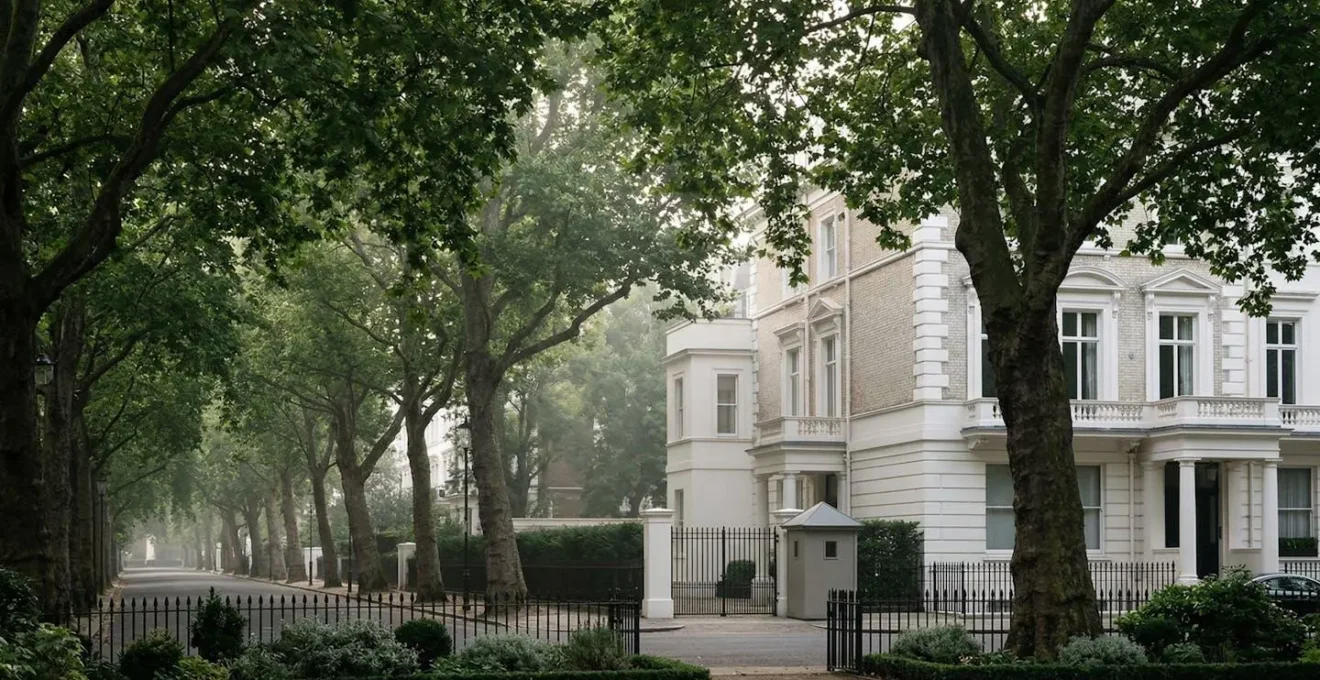
The £25,000 per square metre price difference between Kensington’s top addresses is not arbitrary; it is dictated by a precise hierarchy of security, privacy, and structural precedent.
- The ‘Security Dividend’ from embassy proximity and the exclusivity of off-market channels are tangible, bankable assets.
- Navigating planning for ‘iceberg’ basements and understanding the ‘social topography’ of garden squares are critical to unlocking true value.
Recommendation: Focus less on the W8 postcode and more on a specific street’s position within this unspoken value matrix to make a truly informed acquisition.
For the discerning global buyer, the Royal Borough of Kensington and Chelsea (RBKC) presents a unique puzzle. It is understood that a property here represents a pinnacle of London real estate, yet the internal value dynamics remain opaque to all but the most seasoned insiders. Why does one street command a price per square metre double that of another, seemingly identical one just a short walk away? Many will point to the obvious: proximity to prestigious schools, the lush expanses of Holland Park and Kensington Gardens, and the beautiful period architecture. These are, of course, foundational truths.
However, these factors are merely the entry price to the market. They do not explain the profound value delta between a property on Kensington Palace Gardens and one on a nearby garden square. The real drivers are a far more complex and subtle matrix of unspoken social codes, structural precedents, and security dividends. True value is not simply in the location, but in its specific position within a granular hierarchy of desirability. It’s a world where privacy is a tradable commodity and planning history dictates future wealth.
This analysis will deconstruct the hidden mechanics that govern property value in RBKC. We will move beyond the postcode to explore the tangible financial impact of embassy-level security, the high-stakes process of securing planning for subterranean extensions, the nuanced character of different garden squares, and the discreet world of off-market transactions. By understanding this value matrix, you can move from being a buyer to being a strategic investor in one of the world’s most exclusive property markets.
To navigate this complex landscape, this guide breaks down the key drivers of value that define Kensington’s unique property hierarchy. The following sections provide a granular analysis of the factors that truly matter at the highest end of the market.
Summary: Decoding Kensington’s Property Value Gap
- Why Do Properties Near Embassies in Kensington Sell for 30% More Despite Restricted Access?
- How to Get Planning Permission for a Basement Extension in Kensington’s Conservation Areas?
- Kensington Square or Edwardes Square: Which Garden Square Suits a £10M Family Purchase?
- The Kensington Iceberg Basement That Went £800,000 Over Budget Due to Unforeseen Ground Conditions
- When to Buy in Kensington: Before September School Term or During Summer Lull?
- Why Do 40% of £5M+ London Sales Happen Without Ever Being Publicly Listed?
- Why Does a 200sqm Duplex Feel Larger Than a 220sqm Single-Floor Apartment?
- Why Does a Duplex Penthouse in Manchester Cost Triple a Single-Level Apartment of the Same Size?
Why Do Properties Near Embassies in Kensington Sell for 30% More Despite Restricted Access?
The concept of a “security dividend” is the single most powerful force at the apex of Kensington’s value hierarchy. For the ultra-high-net-worth (UHNW) individual, absolute privacy and security are not amenities; they are non-negotiable prerequisites. This is most vividly demonstrated on Kensington Palace Gardens, often dubbed “Billionaires’ Row.” Here, the proximity to numerous embassies and diplomatic residences creates a de facto private enclave in the heart of London. The market prices for properties in the street average over £35 million, a figure driven not just by the scale of the homes but by this unique security infrastructure.
The perceived inconvenience of restricted access is, for the target buyer, its greatest asset. It filters out all non-essential traffic and provides a level of passive surveillance and active response that no private security firm could ever replicate. This creates an environment of unparalleled tranquillity and safety, a commodity for which the global elite are willing to pay an exponential premium.
Both ends of the street have armed police checkpoints (Diplomatic Protection Group officers) with crash barriers as well as the original wrought-iron gates. This has the side effect of leading to extremely low traffic volumes for a central London street.
– Wikipedia contributors, Kensington Palace Gardens article
This “fortress effect” means that properties on streets with a high concentration of diplomatic missions—such as those around Palace Green—are valued on a completely different metric. The 30% premium is not an arbitrary figure; it is the market’s quantification of guaranteed peace of mind. Buyers are not just acquiring real estate; they are acquiring a level of seclusion and protection that is simply unattainable elsewhere in a central city location.
How to Get Planning Permission for a Basement Extension in Kensington’s Conservation Areas?
In a borough where lateral space is the ultimate luxury, the “iceberg basement” became the definitive method for expanding a property’s footprint without altering its historic facade. However, a past development “gold rush” has been met with some of the UK’s most stringent planning regulations. Data shows that the Royal Borough has witnessed a dramatic surge in basement planning applications, rising from 46 in 2001 to 450 in 2013, prompting the council to impose strict controls under its Supplementary Planning Document (SPD).
Securing permission is no longer a simple architectural exercise; it is a complex, multi-disciplinary undertaking. The primary hurdle is the ground itself. Much of Kensington sits on the challenging London Clay formation, a dense, unstable soil that swells and shrinks with moisture content. This, combined with a network of subterranean “lost rivers” like the Westbourne, presents significant engineering and hydrogeological risks that must be professionally mitigated before any application is even considered.
As the image of a London Clay sample suggests, the ground is a complex, layered medium requiring specialist analysis. A successful application hinges on demonstrating to the RBKC planning authority that the proposed excavation will not adversely affect the water table, neighbouring properties, or the area’s structural integrity. This requires a formidable team of experts and a meticulously prepared submission. The process is a high-stakes test of an owner’s commitment, resources, and professional advisory team.
Your Action Plan: Key Steps for a Successful Basement Application
- Engage with RBKC’s pre-application advice service to align plans with the Supplementary Planning Document (SPD) on basements before formal submission.
- Commission a Geotechnical Survey and Hydrogeological Report to assess London Clay formation and identify subterranean ‘lost rivers’ like the Westbourne that pose flooding risks.
- Limit basement excavation to a maximum of 50% of the garden or open site area, as mandated by Policy CL7.
- Engage structural engineers, hydrogeologists, and archaeologists to mitigate risks of Roman or medieval finds that could halt projects.
- Negotiate Party Wall Agreements with all adjoining neighbours, budgeting for significant legal fees and potential contentious processes.
Kensington Square or Edwardes Square: Which Garden Square Suits a £10M Family Purchase?
Not all garden squares are created equal. For the UHNW family buyer, the choice between two prime squares like Kensington Square and Edwardes Square is not about which is “better,” but which aligns with their lifestyle and social identity. This is the concept of “social topography” in action. Kensington Square, being one of London’s oldest, offers grand Georgian homes and a more cosmopolitan, “urban intellectual” character due to its proximity to the bustle of High Street Kensington. It features a mix of entire houses and large lateral conversions, appealing to those who desire impressive entertaining space.
Edwardes Square, by contrast, offers a different proposition. It is a masterpiece of Regency planning, architecturally harmonious and exuding an air of discreet “old money.” The houses are often smaller but prized for their architectural purity. The garden itself is more exclusive, governed by a strict resident’s committee, reinforcing its private, village-like feel. This appeals to buyers seeking maximum privacy and a community of like-minded, established families. It is also situated firmly in the catchment area for the prestigious French Lycée, a key driver for international buyers. The value here is in the coherence and seclusion, with recent analysis of the W8 6 postcode sector showing top properties achieving over £18,680 per square metre.
| Criterion | Kensington Square | Edwardes Square |
|---|---|---|
| Architectural DNA | Grand Georgian homes, mixed houses and converted flats | Architecturally ‘perfect’ Regency houses |
| Social Character | Cosmopolitan ‘urban intellectual’ crowd | Discreet ‘old money’ and international set |
| Garden Access | More public-facing communal garden | Highly exclusive key-access-only garden with strict committee |
| Proximity to Schools | Close to Wetherby Prep | French Lycée catchment area |
| Property Type | Lateral space, often conversions | Smaller pristine houses, architectural purity premium |
| Ambience | Proximity to High Street Kensington bustle | Secluded ‘village’ feel, maximum privacy |
A £10M family purchase decision therefore transcends simple metrics of size or price. It is a strategic choice about community, schooling, and lifestyle. Choosing the right square is about finding the perfect fit within Kensington’s nuanced social fabric.
The Kensington Iceberg Basement That Went £800,000 Over Budget Due to Unforeseen Ground Conditions
While a basement extension can add immense value, the financial and logistical risks are substantial, a lesson learned the hard way by many. The title of this section isn’t hypothetical; it reflects the real-world consequences of underestimating Kensington’s unique geological and archaeological challenges. The £800,000 over-budget scenario is a composite of common pitfalls that arise from so-called “unforeseen” ground conditions—conditions that a seasoned project team should, in fact, anticipate.
Case Study: The Compounding Risks of Subterranean Development
The RBKC’s stringent basement policy was developed in direct response to a surge in projects that caused significant disruption. Key documented risks that frequently derail budgets and timelines include: hydrogeological issues from historic underground rivers like the Westbourne, which can cause flooding during excavation; unexpected pockets of unstable soil within the London Clay requiring costly engineering solutions; and the discovery of Roman or medieval archaeological finds. The latter can trigger an immediate stop-work order and mandated archaeological surveys that can halt a project for months, incurring massive standing costs for contractors and equipment.
Mitigating these risks requires a proactive and heavily front-loaded due diligence process. A standard contingency fund is insufficient. A successful project requires contractual armour, typically a JCT Design & Build contract that clearly assigns liability for ground condition risks. Furthermore, a separate contingency reserve of at least 20% of the build cost, specifically ring-fenced for these issues, is a prudent measure. This is in addition to the initial, non-negotiable costs of commissioning detailed Geotechnical and Hydrogeological reports before a single design is finalised.
Finally, the human element is a major risk factor. Contentious Party Wall Agreements with adjoining neighbours can spiral into lengthy and expensive legal battles. A buyer must budget not only for the build itself, but for the significant professional and legal fees required to protect the project from its inception.
When to Buy in Kensington: Before September School Term or During Summer Lull?
Timing a purchase in the Kensington market is a strategic decision that can significantly impact both price and choice. The market operates on two distinct seasonal cycles, each offering different opportunities for the prepared buyer. The most frantic period is the “September rush,” the months from late spring to late summer, driven by international families relocating to London. Their primary goal is to secure a home and a school place before the start of the academic year in September. This creates a highly competitive seller’s market, with limited stock often attracting multiple bids.
In contrast, the “summer lull” in late July and August presents a different dynamic. Many local sellers and buyers are on holiday, transaction volumes dip, and the market becomes noticeably quieter. Properties that failed to sell during the spring rush may linger, and new listings are scarce. While this means less choice, it creates a powerful window of opportunity for a chain-free, well-advised buyer who is ready to act decisively. Sellers who remain are often more motivated, and the reduced competition allows for more effective negotiation.
The key is preparation. A buyer targeting the summer lull must have their financing in place, their legal team on standby, and a clear acquisition strategy. This is not a time for casual browsing but for surgical strikes on well-priced assets. As one market analysis summarises:
The pre-September rush is a seller’s market, driven by international families needing to secure a home for the school year. The ‘summer lull’ is when many local sellers and buyers are away, creating a quieter market where a prepared, chain-free buyer can negotiate more effectively on properties that linger.
– Market analysis synthesis, Kensington market seasonality patterns
Therefore, the best time to buy depends entirely on the buyer’s priorities. For maximum choice, brave the pre-September market. For maximum negotiating leverage, prepare for a decisive move during the quiet summer months.
Why Do 40% of £5M+ London Sales Happen Without Ever Being Publicly Listed?
One of the defining characteristics of the prime central London property market is the prevalence of “off-market” or “private” sales. This is a discreet ecosystem where the most desirable properties change hands without ever appearing on public portals like Rightmove or Zoopla. For the UHNW segment, this is the preferred method of transaction. Recent authoritative research confirms the scale of this phenomenon; Hamptons research reveals that in 2023, 54% of properties valued at £5m or more were sold off-market.
The reasons for this are threefold and rooted in the psychology of the UHNW seller. Firstly, privacy is paramount. Sellers in this bracket have no desire for their homes to be publicly exposed, nor do they wish to entertain viewings from unqualified or merely curious parties. Secondly, it avoids the ‘stale scent of failure’. A property that lingers on the public market and undergoes price reductions is perceived as flawed. The off-market approach allows a seller to test a high price point discreetly among a pre-vetted pool of potential buyers.
The Mechanics of the Off-Market Ecosystem
The system operates on a structured network of trust and reputation. A director-level agent at a top-tier firm (e.g., Savills, Knight Frank) is engaged by the seller. Instead of a public listing, this agent “soft markets” the property to a small, trusted circle of elite buying agents who represent qualified UHNW clients. This creates an environment of manufactured scarcity and exclusivity. Paradoxically, by limiting the pool of buyers, sellers can often achieve higher prices as motivated individuals compete for a unique, ‘secret’ opportunity. Access to this deal flow is impossible without representation by a well-connected buying agent who is part of this inner circle.
For a UHNW buyer, understanding this is critical. A significant portion of the best available stock is invisible to them unless they are properly represented. Relying solely on public listings means missing out on over half of the opportunities in their target price range. Engaging with the off-market world is not an option; it is a necessity for serious acquisition in Kensington.
Why Does a 200sqm Duplex Feel Larger Than a 220sqm Single-Floor Apartment?
In the world of Kensington property, perceived volume can be more valuable than raw square meterage. This is particularly true when comparing duplex apartments to large lateral (single-floor) conversions. While a 220sqm lateral flat may seem superior on paper, its layout within a converted Victorian building can often be compromised. Many are long, narrow ‘railroad’ style apartments, where central rooms like hallways, studies, or secondary bathrooms suffer from a lack of natural light and feel like transitional, rather than destination, spaces.
A well-designed 200sqm duplex, however, offers a powerful psychological advantage through functional zoning. It allows for a clear, house-like separation of living areas. Typically, one floor is dedicated to public and entertaining spaces—a grand reception room, dining area, and kitchen—while the other floor is a private sanctuary for bedrooms and en-suites. This vertical separation creates a distinct mental shift between the ‘public’ and ‘private’ zones of the home.
A 220sqm lateral flat can often be a long, narrow ‘railroad’ layout with compromised light in the middle. A 200sqm duplex allows for a clear, house-like separation: a grand reception/entertaining floor and a separate, private bedroom floor. This functional zoning creates the psychological feeling of a much larger, more coherent home.
– Spatial design analysis, Victorian conversion layout patterns in Kensington
This layout efficiency means that almost all of the 200sqm is perceived as usable, prime living space, whereas a significant portion of a 220sqm lateral apartment can feel like compromised circulation area. The duplex offers better light (with potential for double-height spaces), greater privacy for family members, and a sense of grandeur that often eludes single-floor living. For a UHNW buyer, this feeling of a ‘house in the sky’ is often more desirable than a larger but less efficient lateral footprint.
Key Takeaways
- Value is granular: True property value in Kensington is determined street-by-street, not by the general postcode.
- Intangibles are bankable: The premiums for security, privacy, and exclusivity are quantifiable and form a major part of a property’s worth.
- Process is paramount: Successfully navigating the planning system and the off-market network are essential skills for any serious acquisition.
Why Does a Duplex Penthouse in Manchester Cost Triple a Single-Level Apartment of the Same Size?
While a trophy penthouse in a major regional city like Manchester commands a significant premium, its value multiplier operates within a local or national context. In Prime Central London, and specifically Kensington, the premium for a true penthouse is exponential, driven by a set of factors that place it in a global asset class, comparable to fine art or a rare timepiece. The average house price in Kensington of £1.18 million serves as a baseline, but the penthouse market operates on an entirely different plane, achieving multipliers of 5x to 10x over standard apartments in the same building.
This exponential leap in value is not merely about being “on the top floor.” It is about the convergence of three irreplaceable elements that create a “halo product” understood by the global UHNW community.
The Anatomy of London’s ‘Halo Product’ Penthouse
Developments like One Hyde Park exemplify this principle. The penthouse premium is driven by: 1) Irreplaceable Protected Views: Unobstructed, legally protected panoramas of Royal Parks (Hyde Park, Kensington Gardens) or the River Thames that can never be built out. 2) True Five-Star Hotel Integration: Not just a concierge, but seamless integration with an adjoining world-class hotel, such as the Mandarin Oriental at One Hyde Park, providing everything from in-residence dining to housekeeping. 3) Fort Knox-Level Security: Private lifts, iris scanners, and dedicated security teams often comprised of ex-special forces personnel. When these elements are combined with a world-renowned architect (e.g., Rogers Stirk Harbour + Partners) and a luxury brand (e.g., Raffles, Bvlgari), the property transcends real estate to become a globally recognised branded asset.
This is why the London penthouse premium dwarfs that of other cities. The asset is not being compared to other local properties; it is being compared to similar “halo products” in New York, Hong Kong, or Monaco. The buyer is acquiring a position in a highly exclusive global club, and the price reflects that unique status.
To effectively navigate this complex and nuanced property landscape, the next logical step is to align with a specialist advisor who possesses the granular knowledge and network access required to identify and secure these premier assets.