The dramatic price difference between prime Surrey estates is driven by a ‘Prestige Hierarchy’ where perceived status, access quality, and lifestyle insulation multiply value far beyond acreage or property size.
- A location’s brand, like Virginia Water, and its proximity to exclusive amenities like Wentworth Golf Club, creates a non-negotiable price floor.
- True value lies in ‘lifestyle insulation’—the security and privacy offered by gated communities and substantial grounds, which command premiums of 15% or more.
Recommendation: Instead of comparing square footage, analyse a property’s position within this hierarchy of access and exclusivity to understand its true market value.
For any discerning buyer entering the Surrey country estate market, the paradox is immediate and perplexing. How can two substantial properties, both offering ten acres of prime English countryside, have a value delta stretching into the millions? The common answer—proximity to London—is a gross oversimplification. It explains the baseline premium for Surrey as a whole, but it fails to decode the vast chasm between a £10 million estate in Virginia Water and a £5 million equivalent in Haslemere. This disparity isn’t just about mileage; it’s about a complex, unwritten code of prestige, access, and lifestyle.
Most market analysis focuses on tangible metrics: square footage, number of bedrooms, and the quality of finishes. While important, these factors are secondary in Surrey’s super-prime echelon. The real value drivers are more nuanced. They are about the subtle difference between being inside or outside the M25, the friction of a National Rail commute versus a seamless Zone 6 journey, and the perceived status attached to certain postcodes. It’s a market governed by a ‘Prestige Hierarchy’ where a property’s address can be a more significant asset than the house itself.
But if the key isn’t just location, what is it? The answer lies in understanding the matrix of ‘micro-market dynamics’. This is about the value of ‘lifestyle insulation’—the premium placed on privacy, security, and access to an exclusive social ecosystem. This guide moves beyond the obvious to explain the underlying mechanics of Surrey’s property hierarchy. We will deconstruct the premiums commanded by A-list commuter towns, explore the financial impact of gated security, and reveal why even the most expensive property improvements can fail to add equivalent value if they don’t align with a location’s specific buyer profile.
This article will dissect the key questions that determine a Surrey estate’s true worth. By exploring these factors, you will gain the specialist insight needed to navigate the market, understand the logic behind the prices, and identify where genuine value lies.
Summary: Deconstructing the Value of a Prime Surrey Estate
- Why Do Properties Within 3 Miles of Weybridge Station Command 25% Premiums?
- How to Extend Your Surrey Farmhouse Without Violating Green Belt Planning Rules?
- Cobham or Cranleigh: Which Surrey Location Balances Privacy with London Accessibility?
- The £500,000 Stable Complex That Added Only £150,000 to Your Property’s Market Value
- When to Buy Surrey Countryside: When London Prices Peak or After Rural Demand Surges?
- Why Does Crossing from Zone 6 to National Rail Add 20% to Your House Budget?
- Why Does Your Home Insurance Drop by 20% When You Move Behind Controlled Gates?
- Why Do Properties Behind Electric Gates Achieve 15% Higher Prices Than Open Equivalents?
Why Do Properties Within 3 Miles of Weybridge Station Command 25% Premiums?
The concept of a ‘commuter premium’ is the foundational rule of the Surrey property market. Locations offering a fast, direct, and frequent service into London Waterloo will always sit at the top of the price hierarchy. Weybridge is a prime example. It’s not just about the journey time (around 30 minutes); it’s about the quality and frequency of access. This reliability allows residents to enjoy a countryside lifestyle without compromising their connection to the capital, creating intense demand that props up values. The premium isn’t just a perception; it’s a quantifiable market reality.
This price inflation is stark when compared to the wider county. While Surrey is affluent, certain pockets carry a disproportionate value. Research consistently demonstrates this effect, with A-list commuter towns maintaining a significant lead over their neighbours. For instance, according to research from Lloyds Bank, the average house price in Weybridge has been noted at figures around £822,672, placing it firmly in the upper echelons of London’s commuter belt. This premium reflects a buyer’s willingness to pay for convenience, reduced travel friction, and the status associated with a well-connected address.
However, the premium extends beyond the station itself. The three-mile radius is critical because it represents the “golden zone” of convenience. Within this area, residents can typically reach the station in under 10 minutes, avoiding the pain points of traffic or long drives that dilute the benefit of a fast train. This halo effect supports values for properties not just in Weybridge itself, but also in exclusive private estates like St George’s Hill, which fall within this coveted catchment area. The 25% premium is, therefore, a tax on effortless connectivity.
How to Extend Your Surrey Farmhouse Without Violating Green Belt Planning Rules?
For many buyers of country estates, the potential to extend or redevelop is a key consideration. However, much of Surrey’s most desirable countryside is protected by Green Belt legislation, which imposes strict limitations on development. The standard rule of thumb is that you cannot extend a property beyond a certain percentage of its original size. For many areas, this can be a significant constraint on realising a property’s full potential, capping the size of extensions and ancillary buildings.
The baseline for development is often tightly controlled. Planners aim to prevent the unrestricted sprawl of buildings in these protected landscapes. As a general guide, most councils in Surrey follow a principle that extensions should not exceed a 30% to 50% increase over the volume of the ‘original’ dwelling (as it stood in 1948, or when first built). This can be a shock for buyers with grand designs, as it can severely limit the scope for creating the large, modern living spaces they desire. This is a critical piece of due diligence before any purchase.
However, for the informed buyer and their specialist team, there are strategic routes to navigate these restrictions. The key lies in understanding the nuances of planning law, particularly Permitted Development Rights (PDR). In certain circumstances, PDR can allow for extensions that fall outside the standard Green Belt policy, offering a valuable ‘uplift’. This requires a sophisticated approach, often involving a clear understanding of the property’s planning history and the specific policies of the local authority. It is not a DIY task but a specialist endeavour.
Case Study: Strategic Uplift in the Green Belt
This principle was demonstrated effectively by planning consultants at Corbil Planning for a property near Addlestone. The site was constrained by a typical Green Belt policy that would have limited any extension to just 30%. However, by strategically leveraging Permitted Development Rights, they successfully secured permission for a development that represented a 180% increase in gross internal area and a 135% increase in volume. This case highlights that with expert guidance, the perceived limits of Green Belt policy are not always absolute.
Cobham or Cranleigh: Which Surrey Location Balances Privacy with London Accessibility?
Once a buyer moves beyond the primary need for a London commute, the decision-making process shifts to lifestyle matching. This is where the ‘Prestige Hierarchy’ becomes most apparent, illustrated perfectly by the choice between a location like Cobham and one like Cranleigh. Both offer beautiful properties and a village atmosphere, but they serve very different segments of the market. Cobham is pure ‘A-list’ territory, defined by its polished high street, proximity to the A3 and M25, and a concentration of high-net-worth residents. Its value is tied to manicured accessibility.
The property prices in Cobham reflect this top-tier status. It’s a market where demand is consistently high from both international buyers and City executives. According to Land Registry data, the average sold price stands at over £1,084,034, a figure heavily influenced by the multi-million-pound estates within its private roads. This price commands access to an ecosystem of elite schools, trendy restaurants, and a social scene that is palpably exclusive. It offers privacy, but it is a highly visible, ‘on-the-map’ form of privacy.
Cranleigh, by contrast, offers a different proposition. It provides a more authentic, rural village experience. While still affluent, it lacks the direct, high-speed transport links of Cobham, meaning it appeals to buyers for whom a daily London commute is less of a priority. The trade-off for this reduced accessibility is often more land for your money and a deeper sense of seclusion. It’s a choice between Cobham’s ‘connected privacy’ and Cranleigh’s ‘secluded privacy’. The right choice depends entirely on the buyer’s lifestyle priorities: the buzz of the A-list social circuit or the quiet retreat of the deeper countryside.
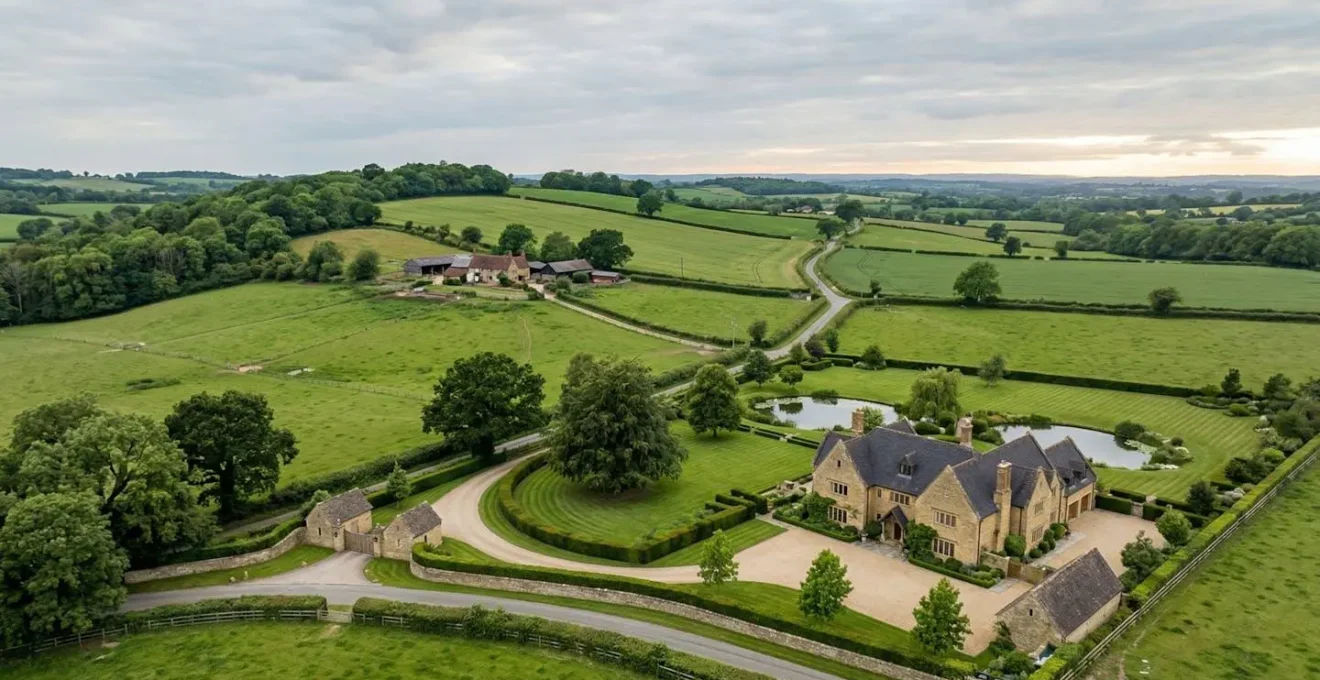
As this view of a secluded Surrey estate demonstrates, the ultimate luxury is often ‘lifestyle insulation’—the ability to be close to everything while feeling removed from it all. This is the balance that locations like Cobham strive to perfect, and it is a significant component of their premium value.
Your Surrey Property ‘Prestige Audit’ Checklist
- Access Friction Analysis: Map the full door-to-desk journey time, including the drive to the station and platform waiting time. Is it a direct line or does it require changes?
- Amenity Ecosystem: List the ‘trophy’ amenities within a 15-minute drive (e.g., Wentworth/Sunningdale golf clubs, Guards Polo Club, Michelin-starred restaurants, specific international schools).
- Insulation Factor: Is the property on a public road or a private, gated estate? Assess the distance and visibility from the nearest public highway.
- Postcode Prestige: Research the postcode’s reputation. Is it known as an ‘A-list’ location (e.g., KT11 for Cobham) or a more discreet, ‘B-list’ alternative?
- Neighbourhood Profile: Walk the local high street. Does it cater to everyday needs or a luxury lifestyle (e.g., independent boutiques, high-end delicatessens vs. standard chain stores)?
The £500,000 Stable Complex That Added Only £150,000 to Your Property’s Market Value
A common misconception among property owners is that the cost of an improvement directly translates into added market value. This is rarely the case, particularly in the specialised world of country estates. Equestrian facilities are a classic example. A state-of-the-art stable block, complete with an Olympic-sized manège and luxury tack rooms, can easily cost £500,000 or more to build. However, a valuer might only attribute £150,000 of that expenditure to the property’s overall market price. This ‘value vs. cost disconnect’ can be a source of significant frustration.
The reason for this discrepancy lies in market appeal. While high-quality equestrian facilities are a major selling point, they only appeal to a small, specific subset of buyers. For a non-equestrian family, that expensive stable block is not an asset; it’s a liability that requires maintenance. The value of such a feature is therefore entirely dependent on finding the right buyer, in a location known for its equestrian community (like the villages around Guildford or in the Surrey Hills). In a prime commuter town like Esher, where buyers prioritise school catchments and fast transport links, the same facilities will have a much lower perceived value.
This principle underscores the importance of context. The most successful improvements are those that align with the aspirations of a location’s target demographic. As leading experts in the field often caution, capital expenditure must be carefully weighed against the likely return.
The craftsmanship and quality of materials, as seen in this detail of a premium stable, are undeniable. Yet, their financial value is only fully realised when the property is marketed to the correct audience in the right location. This is where a specialist’s understanding of micro-market demand becomes invaluable.
be realistic: the added value may be less than the expenditure needed to create the new facilities
– Savills equestrian property specialists, Savills Blog: Five ways to add value to your equestrian property
When to Buy Surrey Countryside: When London Prices Peak or After Rural Demand Surges?
Timing the market is notoriously difficult, but understanding the relationship between the London and Surrey property cycles can provide a strategic advantage. Historically, the two markets have a correlated but lagged relationship. Typically, a boom in the London market, driven by finance sector bonuses and international investment, is followed 6-18 months later by a surge in demand for prime Surrey estates. This is the ‘wealth ripple’ effect, as successful Londoners cash in their city properties to buy their dream country home.
Therefore, the most opportune moment to buy in Surrey is often not when the rural market is already hot, but in the period just as the London market is showing signs of peaking. At this point, London homeowners have the equity and confidence to make a move, but the wave of demand has not yet fully hit the home counties. This can create a window of opportunity for buyers to acquire property before competition intensifies and prices are driven up further. Waiting until rural demand has clearly surged means you are already behind the curve and likely paying a premium.
The current market provides a compelling illustration. While Surrey as a whole remains significantly more expensive than the national average, there are signs that the very top of the market has cooled from its post-pandemic peak. For example, in the ultra-prime enclave of Virginia Water, Land Registry statistics reveal that average prices have slightly softened from a peak of £2.1 million. For a strategic buyer, such moments of consolidation in A-list locations can represent a more favourable entry point than chasing a rapidly appreciating market in a less-established area.
Why Does Crossing from Zone 6 to National Rail Add 20% to Your House Budget?
The distinction between a property served by the London transport network (TfL Zones 1-6) and one reliant on National Rail services is one of the most significant, yet often overlooked, factors in the Surrey property hierarchy. On a map, two locations might appear equidistant from Central London. However, if one is at the end of a tube line in Zone 6 and the other requires a separate National Rail ticket, the impact on lifestyle, cost, and ultimately property value is immense. This is the concept of ‘access friction’.
A property within Zone 6 offers seamless, integrated travel. Residents can use a single Oyster or contactless card for their entire journey, with capped daily and weekly fares. This provides cost predictability and unparalleled convenience. The moment you cross into National Rail territory, this simplicity vanishes. Commuters face significantly higher ticket prices, the complexity of separate ticketing systems, and often, services that are less frequent or reliable outside of peak hours. A season ticket from a prime Surrey town like Woking can cost thousands of pounds more per year than commuting from a Zone 6 location like Epsom.
This added cost and friction are capitalised into house prices. Buyers are willing to pay a substantial premium for the convenience and lower running costs of being within the TfL network. A 20% budget increase to secure a Zone 6 property over a similar one just outside the boundary is not an exaggeration; it is a rational financial decision. It represents the capitalised value of thousands of pounds in saved travel costs and countless hours of reduced travel-related stress over the lifetime of owning the home. This is why towns on the very edge of the zones, like Epsom or Tadworth, command such strong and resilient values.
Why Does Your Home Insurance Drop by 20% When You Move Behind Controlled Gates?
The appeal of a gated community or a private estate with controlled access goes far beyond prestige; it has a direct and measurable financial benefit in the form of lower home insurance premiums. From an insurer’s perspective, risk assessment is a game of statistics. A property located behind secure, monitored gates presents a significantly lower risk profile than an equivalent property on a publicly accessible road. This reduction in risk translates directly into a reduction in premiums, which can be as much as 20%.
The logic is straightforward. Controlled gates act as a powerful deterrent to opportunistic crime. They dramatically reduce the likelihood of burglary, vandalism, and vehicle theft. A potential thief cannot simply drive by and identify a target; they are faced with a physical barrier and, often, the presence of security personnel or CCTV. This creates a highly effective first line of defence. Insurers recognise that the claims frequency from properties within these secure enclaves is substantially lower, and they price their policies accordingly.
This insurance discount is a tangible return on the ‘lifestyle insulation’ that buyers in this market actively seek. It financially validates the premium paid for the property itself. The saving of several hundred or even thousands of pounds a year on insurance is a direct capitalisation of the security and peace of mind that a gated environment provides. It is another layer in the complex matrix of value, where a feature of the location (security) directly impacts the ongoing cost of ownership, thereby reinforcing the initial property value.
Key Takeaways
- Surrey’s property value is a ‘Prestige Hierarchy’; the address and its associated status can be worth more than the physical asset.
- ‘Lifestyle Insulation’, provided by gates and large grounds, is a key value multiplier, reducing risks and increasing exclusivity.
- ‘Access Friction’ is critical: a Zone 6 location offers a seamless commute that adds a significant, quantifiable premium over a nearby National Rail town.
Why Do Properties Behind Electric Gates Achieve 15% Higher Prices Than Open Equivalents?
The 15% premium often associated with properties behind electric gates is the market’s way of pricing in ‘lifestyle insulation’. This premium is not just an arbitrary figure; it represents the value buyers place on three key factors: security, privacy, and status. In a world of increasing population density, the ability to control one’s immediate environment has become the ultimate luxury. Electric gates are the most visible symbol of this control, acting as a clear boundary between the public realm and the private sanctuary of the home.
Security is the most practical driver of this value. As discussed, gated access deters crime and lowers insurance costs. But the value of privacy is equally, if not more, important to the high-net-worth buyer. Gates prevent unsolicited visitors, stop vehicles from using a driveway as a turning point, and shield the property from prying eyes. This creates a sense of peace and seclusion that is difficult to achieve on an open-frontage property. It allows a family to use their entire grounds freely, without concern for external observation.
Finally, there is the undeniable element of status. In prime Surrey, imposing gates are a signal. They communicate exclusivity and success, reinforcing the property’s position at the top of the residential hierarchy. They are the finishing touch on a ‘fortress’ of personal space. The 15% premium is therefore a composite valuation: a payment for tangible security, the intangible comfort of privacy, and the perceived status that comes with an exclusive and protected address. It is the price of total control over one’s domain.
The commanding presence of gates like these is more than just a security feature; it’s a powerful statement about the property’s standing. They physically and psychologically separate the estate from the outside world, creating the insulated environment that commands a market premium.
Ultimately, navigating the Surrey estate market requires moving beyond simplistic metrics and adopting the mindset of a specialist. Understanding the subtle interplay of the Prestige Hierarchy, Access Friction, and Lifestyle Insulation is the only way to decode the seemingly illogical price variations and identify true, lasting value. For a comprehensive evaluation of a specific property against these critical benchmarks, a personalised consultation is the logical next step.