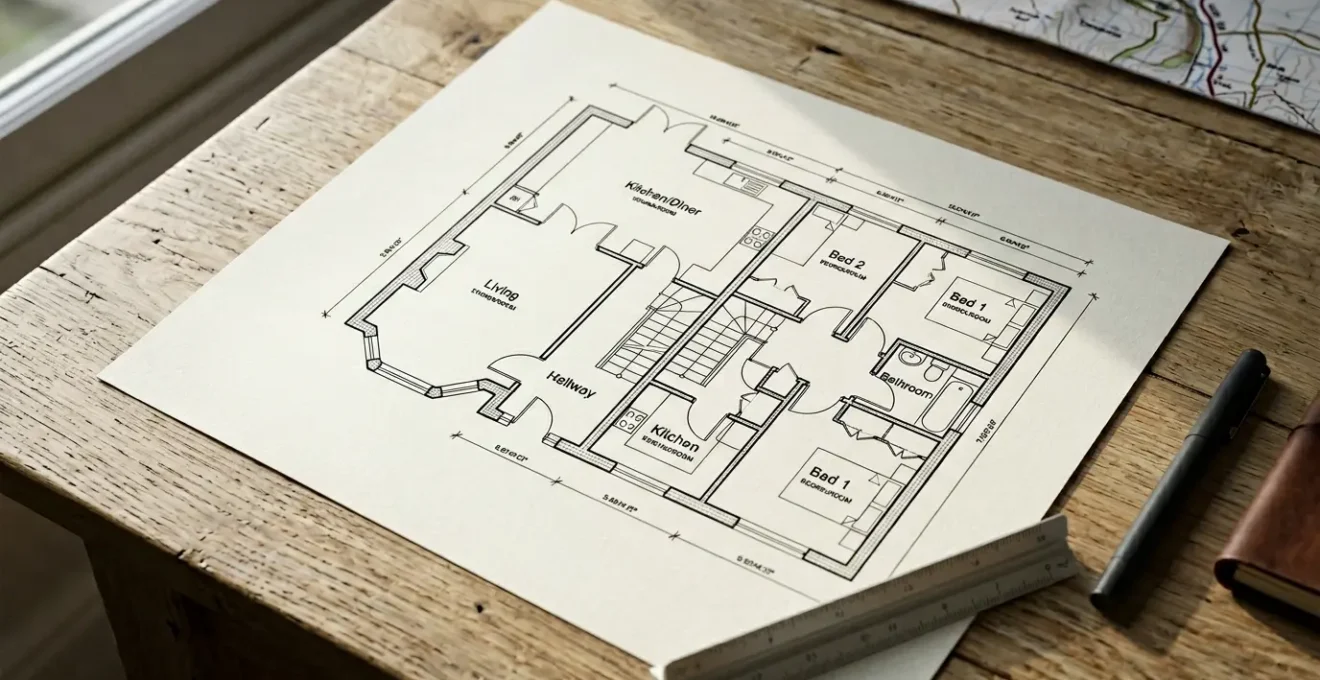
A professional floorplan is not a listing expense; it is one of the highest ROI marketing assets in property sales, directly converting buyer uncertainty into quantifiable value.
- Inaccurate or absent floorplans create a “trust cascade failure,” making buyers question the entire listing and costing you serious enquiries.
- Strategic furniture placement on a plan can make compact spaces feel significantly larger, increasing perceived value far beyond the square footage.
Recommendation: Commission a professionally measured, RICS-compliant floorplan for every listing before it goes live to maximise buyer engagement and secure a higher final offer.
It’s a question every seller and estate agent in England faces: with marketing budgets under scrutiny, is spending £50 or more on a professional floorplan a necessary cost or an optional extra? Many view it as a simple diagram, a basic part of the property marketing package. This perspective, however, overlooks a fundamental truth of property sales. A floorplan is not a passive document; it’s an active sales tool. It’s the first step a buyer takes to mentally move into a property, a critical anchor for trust, and a powerful instrument for justifying value.
While high-quality photography creates desire, the floorplan provides the logic and reassurance needed to convert that desire into a viewing, and ultimately, an offer. The common advice is to “have one because buyers expect it,” but this misses the strategic core of the issue. The real question isn’t whether you need a floorplan, but how you can leverage it to de-risk the purchase for a buyer, build unshakeable trust in your listing’s integrity, and psychologically frame the property’s value to your advantage. The difference between an amateur sketch and a professionally measured plan isn’t just aesthetic; it’s a tangible financial delta that can amount to thousands of pounds.
This article will dissect the strategic value of a floorplan, moving beyond the obvious to explore the powerful psychological and financial mechanics at play. We will demonstrate why its absence is a red flag, how its design can alter spatial perception, why accuracy is non-negotiable, and how its correct deployment can directly translate a small upfront cost into a significantly higher sale price.
To navigate this essential topic, we will explore the core pillars that transform a simple layout drawing into a high-performance marketing asset. The following sections break down the data, psychology, and strategy behind maximising your property’s value through this often-underestimated tool.
Summary: The True Value of a Property Floorplan
- Why Do 80% of Buyers Reject Properties Without Viewing the Floorplan First?
- How to Make a 70sqm Flat Appear More Spacious Through Strategic Furniture Placement on Plans?
- 2D Layout or 3D Render: Which Floorplan Style Sells Period Houses Faster?
- The Square Footage Error That Made Buyers Question Everything Else in Your Listing
- When to Commission Your Floorplan: Before Photography or After Decluttering?
- How Much Does a Private Garden Add to Value Compared to a Shared Courtyard?
- Why Does a 200sqm Duplex Feel Larger Than a 220sqm Single-Floor Apartment?
- Why Does a Duplex Penthouse in Manchester Cost Triple a Single-Level Apartment of the Same Size?
Why Do 80% of Buyers Reject Properties Without Viewing the Floorplan First?
The primary reason buyers disengage from a listing without a floorplan is not a lack of interest, but an abundance of caution. In a competitive market, buyers use floorplans as a crucial disqualification filter. A property is a complex, high-value purchase, and a floorplan works to reduce the cognitive load required to understand it. Without one, the buyer is faced with uncertainty about flow, room relationships, and practicality. Is the family bathroom on the ground floor? Is the master bedroom big enough for their king-size bed? A floorplan answers these questions instantly.
This isn’t speculation; it’s backed by data. Research from Rightmove, the UK’s largest property portal, is stark: 1 in 10 buyers state they would never arrange to view a property if they haven’t seen a floorplan first. Further studies have shown that over 88% of buyers consider them essential. The message is clear: no floorplan introduces a level of risk and effort that a significant portion of the market is simply unwilling to take on. They won’t spend time trying to piece together a mental map from photographs when a competing listing offers them clarity at a glance.
As one survey respondent succinctly put it, “Time is a commodity and there are normally many other properties with a floorplan whom I would rather contact.” In essence, by omitting a floorplan, you are not just providing incomplete information; you are actively encouraging the most organised and decisive buyers—those who do their homework—to view competing properties instead of yours. You are filtering out your best prospects before they even have a chance to see the photos.
How to Make a 70sqm Flat Appear More Spacious Through Strategic Furniture Placement on Plans?
A floorplan’s dimensions are fixed, but the perception of space is highly malleable. For a compact property like a 70sqm flat, a strategically furnished floorplan can be the difference between a buyer seeing it as “cramped” or “efficiently designed.” The key is to use furniture icons not as decoration, but as tools for demonstrating potential and proving functionality. This allows buyers to engage in spatial ownership—mentally placing their own life within the property’s footprint.
This isn’t about deception; it’s about intelligent demonstration. By placing a realistically scaled double bed in a bedroom and showing there is still room for wardrobes and walking space, you answer a buyer’s unspoken question before they even ask it. In an open-plan area, using furniture icons to define distinct ‘zones’—a living area, a dining space, a work-from-home station—proves the versatility of the space in a way that an empty outline cannot.
The visual below illustrates this principle. The careful positioning of miniature furniture within a scale model proves that even a compact layout can be highly functional and feel spacious when planned correctly. This act of pre-planning for the buyer removes a major barrier of uncertainty and helps them envision a comfortable life in the space, directly increasing its perceived value.
Action plan: Creating a Floorplan That Sells Space
- Show Room Dimensions Clearly: Prioritise adding clear room measurements (e.g., 4.5m x 3.2m) to the plan. Buyers consistently rate this as the most important feature.
- Include All Openings: Accurately mark window and door placements, including the direction of door swings. This is critical for buyers to plan their own furniture placement.
- Use Credible Furniture Scales: Position realistic-sized furniture icons (e.g., a 135x190cm double bed, not an undersized one) to build trust and provide a true sense of scale.
- Design for Visual Flow: Ensure key walkways and circulation spaces (e.g., from the living room to the kitchen) are left clear on the plan to demonstrate ease of movement.
- Label Functional Zones: In open-plan areas, use furniture groupings and labels to demonstrate distinct zones like ‘Dining Area’ or ‘Home Office’, proving the space’s flexibility.
2D Layout or 3D Render: Which Floorplan Style Sells Period Houses Faster?
The debate between 2D black-and-white layouts and furnished 3D renders often misses the point. While 3D plans can offer an engaging, almost video-game-like perspective, the most critical factor for a fast sale, especially for complex period properties, is not style but clarity and utility. A clear, accurate, and well-labelled 2D floorplan is infinitely more valuable than a glossy but confusing 3D render. Period houses in England, with their often quirky layouts, non-standard room shapes, and features like split levels or chimney breasts, demand this clarity.
The primary job of the floorplan is to communicate the property’s flow and potential. A 2D plan excels at this by providing a clean, top-down, bird’s-eye view. It allows buyers to quickly understand the relationship between rooms, assess storage options (a key concern in older homes), and see how the layout might accommodate their lifestyle. A 3D render, if poorly executed, can obscure dimensions and create awkward viewing angles that actually hide information.
The data supports the idea that the mere presence of a quality plan is the most important variable. Evidence from Rightmove indicates that adding a floorplan can increase buyer click-throughs by 52%. This huge uplift is driven by the information a plan provides, not its stylistic format. For a period property, the best strategy is often a hybrid approach: a clean 2D plan with key dimensions and total area, potentially supplemented by a 3D view to highlight a specific feature like a vaulted ceiling or open-plan kitchen-diner. The 2D plan remains the workhorse, providing the essential data buyers need to make a decision.
The Square Footage Error That Made Buyers Question Everything Else in Your Listing
Nothing erodes buyer confidence faster than an inaccuracy. A floorplan acts as a trust anchor for the entire property listing. When the measurements are precise and professionally presented, it sends a powerful subconscious message: this seller and agent are transparent, detail-oriented, and trustworthy. Conversely, a small error—a miscalculated square footage or an incorrectly drawn wall—can create a cascade of doubt that taints the entire sale.
If the floorplan is wrong, what else is? Is the boiler really new? Is the leasehold information correct? This is not a hypothetical risk. The Royal Institution of Chartered Surveyors (RICS) has highlighted the scale of the problem, with one guide revealing a potential variance of up to 58% in UK property measurements depending on the standard used. This is why a “DIY” floorplan, while tempting, is a huge strategic error. It’s not a floorplan; it’s a liability.
Commissioning a plan measured by a professional using laser measures and adhering to RICS Property Measurement Standards is a non-negotiable investment. It ensures that the Gross Internal Area (GIA) is calculated consistently and defensibly, providing a solid foundation for valuation and preventing disputes down the line. As RICS itself states, this provides a consistent and transparent way of measuring, ensuring buyers pay a fair price.
It’s vitally important that every room in a property is measured accurately so that buyers and renters pay a fair price, and RICS’ Measurement Matters guide offers just that: a consistent and transparent way of measuring and producing accurate floorplans using RICS’ mandatory Property Measurement Standard
– RICS representative, RICS Measurement Matters consumer guide
When to Commission Your Floorplan: Before Photography or After Decluttering?
The optimal moment to commission a floorplan is guided by a single, powerful piece of data: the ‘golden window’ of property marketing. Your listing will never have more attention than in its first two weeks online. According to Rightmove, 70% of the total interest a property generates happens within this initial period. This means your marketing assets—photos, description, and floorplan—must be perfect and complete from the moment you hit ‘publish’.
Launching a property “coming soon” or with “floorplan to follow” is a catastrophic marketing error. You are effectively telling the most motivated, organised buyers to ignore your property during its peak visibility. The correct strategy is to have all assets prepared and ready to go live simultaneously. The ideal workflow is to schedule the professional floorplan measurement and photography for the same visit, immediately after the property has been fully decluttered and prepared for sale. This ensures consistency and efficiency.
The decluttering stage is crucial. While the measurer can work around furniture, a prepared space allows for quicker, more accurate measurements. More importantly, it aligns the floorplan creation with the photography, creating a cohesive and professional marketing package from day one. As one expert bluntly states, launching an incomplete listing means you miss your one and only chance to make a first impression on the keenest buyers.
Don’t launch with placeholder photos, descriptions or without a floor plan – as you’ll miss your best chance to impress the keenest buyers
– Miles Shipside, Rightmove property expert statement
How Much Does a Private Garden Add to Value Compared to a Shared Courtyard?
This question highlights a critical limitation of photography and a key strength of a professional floorplan: the ability to accurately represent and differentiate high-value external features. While photos can show a beautiful garden, they often struggle to convey its size, its relationship to the house, or, crucially, its boundaries. Is that lovely lawn private, or is it shared? A floorplan provides the definitive answer.
A RICS-compliant plan will clearly delineate the property’s demise line, showing exactly what is included in the title. For a flat in a converted period house, the floorplan is the only tool that can visually prove the difference between a small, private patio and access to a large but shared courtyard. This distinction has a massive impact on valuation and desirability. By clearly marking a “Private Rear Garden” with its dimensions, the floorplan transforms an ambiguous feature into a concrete, valuable asset.
This level of clarity provides a significant competitive advantage, especially given that the practice is far from universal. Industry data suggests that only around 55% of online property listings in the UK contain a floorplan of any kind. This means nearly half of the market is failing to properly merchandise one of the most sought-after features of a property. For sellers with valuable outdoor space, a professional floorplan isn’t just helpful; it is the most effective tool for communicating and justifying a premium price to potential buyers.
Why Does a 200sqm Duplex Feel Larger Than a 220sqm Single-Floor Apartment?
The answer lies in human psychology and the power of vertical zoning. A duplex apartment, by splitting its living space across two floors, mimics the layout of a traditional house. This creates a powerful psychological separation between public and private zones—typically living areas downstairs and bedrooms upstairs. This separation often makes the space feel more organised, more substantial, and therefore larger and more valuable than a single-level apartment of even greater square meterage.
A single-floor apartment, no matter how large, keeps all functions on one plane. A duplex introduces the ritual of moving between floors, which enhances the perception of distinct zones and privacy. However, this perceived value can only be communicated effectively through a high-quality set of floorplans. A single, combined square meterage figure is meaningless; it’s the floor-by-floor breakdown that tells the story.
Case Study: Applying RICS Code of Measuring Practice to Duplexes
The RICS Code of Measuring Practice provides the essential framework for this. The code mandates separate floor-by-floor measurements to accurately calculate the total Gross Internal Area (GIA) for multi-level properties. This approach is not just a technical requirement; it’s a marketing necessity. By presenting two distinct floorplans—’Ground Floor’ and ‘First Floor’—the listing visually reinforces the separation of space. A buyer can immediately see the ‘living floor’ and the ‘sleeping floor’, helping them to understand the lifestyle benefits and justifying the premium that such layouts often command in the UK property market.
Without this clear, multi-plan representation, a buyer looking at a listing for a 200sqm duplex might wrongly compare it to a 200sqm single-level flat, failing to grasp the enhanced utility and perceived status that the vertical separation provides. The floorplan is the tool that makes this abstract psychological benefit a tangible, marketable asset.
Key takeaways
- A professional floorplan is a high-ROI marketing asset, not an administrative cost.
- Accuracy is paramount; RICS-compliant measurements build trust and prevent disputes, while DIY plans create risk.
- A floorplan must be ready on day one of listing to capitalise on the “golden window” of peak buyer interest.
Why Does a Duplex Penthouse in Manchester Cost Triple a Single-Level Apartment of the Same Size?
The premium attached to a duplex penthouse in a prime Manchester development like Deansgate Square is not just about height and views; it’s about demonstrated exclusivity, and the floorplan is the primary document of proof. While photos showcase the luxury finishes, the floorplan proves the unique spatial proposition that justifies the multi-million-pound price tag. It’s the ultimate tool for valuation proof.
For these properties, the floorplan communicates features that are impossible to capture in a single photograph: entire-floor footprints, private lift lobbies that open directly into the apartment, the orientation of terraces for morning or evening sun, and the dramatic volume of double-height living spaces. It transforms from a simple layout diagram into a blueprint for a lifestyle, visually demonstrating a level of privacy and scale that is fundamentally different from the apartment on the floor below.
This is why top-tier sellers and developers invest heavily in high-quality, detailed floorplans. A recent survey showed that 80% of property sellers rated floorplans as ‘essential’ or ‘very useful’. For the luxury market, that figure is effectively 100%. The plan is a critical part of the due diligence for high-net-worth buyers and their advisors, acting as the foundation for the entire value proposition.
Case Study: Reducing Time on Market for Premium Properties
The financial return is clear. A study found that including a floorplan can reduce a property’s time on the market by up to 50%. For a premium penthouse, this is hugely significant. The floorplan pre-qualifies buyers, ensuring that only those who understand and can afford the unique proposition will book a viewing. It eliminates time-wasters and accelerates the journey to a firm offer from a qualified party. The floorplan doesn’t just sell the space; it sells the status, the exclusivity, and the undeniable value that commands a triple-figure premium.
Ultimately, a professional floorplan is one of the most effective and highest-return investments you can make when selling a property. It’s not a legal requirement in England, but it is a commercial necessity. By investing a small sum in an accurate, clear, and strategically considered plan, you are not just ticking a box; you are providing clarity, building trust, and giving buyers the tools they need to justify paying your asking price—and often, even more.